Chains have a measurement. Cassettes do not — there is no equivalent ruler test.
The reliable indicator is behavioural: fit a new chain and pedal hard in the gears you use most. If it skips under load, the cassette is worn.
The mechanism is simple. A worn chain is longer than one inch per link, so its rollers sit progressively further out on each tooth. Over thousands of kilometres the teeth wear into a shape matching that stretched chain — and once reshaped, they no longer accept a correct one-inch pitch.
What worn teeth look like
Sight along the sprockets from the side.
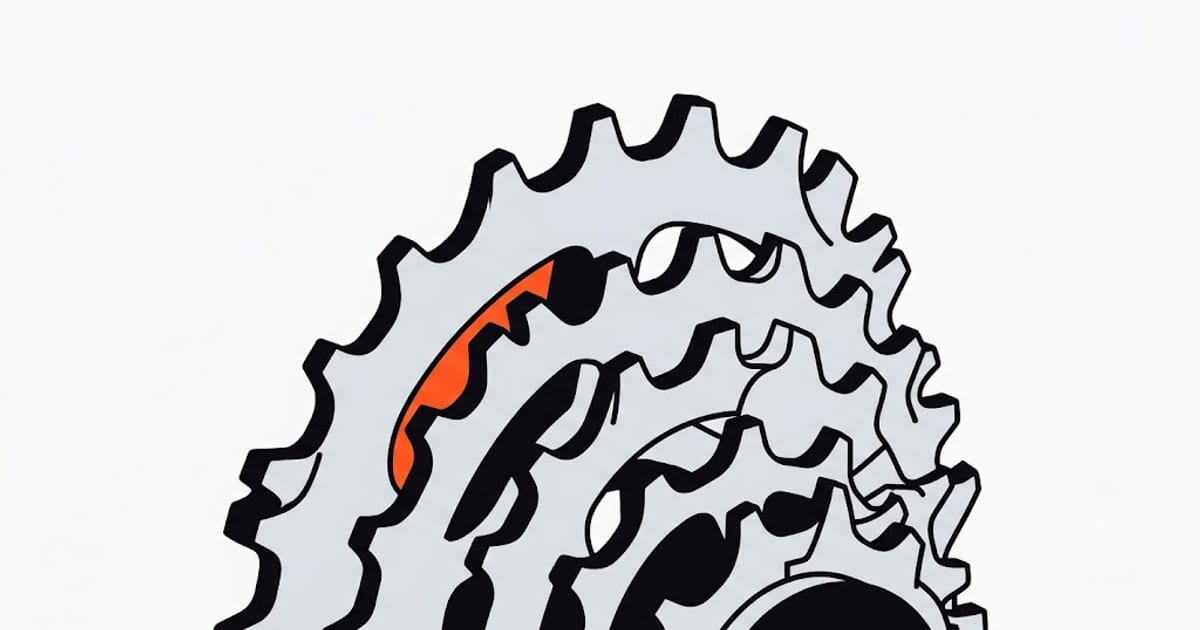
New teeth are symmetrical, with matching curves either side of the point. Worn teeth develop a hooked, shark-fin profile — one face wears back while the other stays, so the tooth leans.
The wear concentrates on the sprockets you use most. A cassette can be visibly hooked on three middle sprockets and near-new at both ends, which is why it can seem fine until you happen to be in the wrong gear under load.
Two or three chains per cassette
Replace chains at the threshold and one cassette typically outlasts two to three of them.
That ratio collapses if chains run past their limit. A chain at 1% elongation reshapes teeth quickly, so a single over-run chain can take the cassette with it.
This is the whole economic argument for measuring chains — see how to measure chain wear. The chain is the cheapest part of the drivetrain and it is the sacrificial one.
Chainrings last longest
Roughly two to three cassettes, so five or more chains.
They last because the load is spread over more teeth, more of the time. A worn chainring shows the same hooked profile, and the symptom is chain drop under load — the chain lifting off the ring rather than skipping on it.
On a 1× drivetrain, the single ring takes all the wear and lasts less than a 2× chainring would.
Replace them together, or not
Chain only — the cassette accepts the new chain without skipping. The common case if chains are replaced on time.
Chain and cassette — the new chain skips. Do both; a new chain on a worn cassette will not stop skipping and will wear itself to match, undoing the replacement.
Everything — the new chain drops off the chainring under load as well. Usually a drivetrain that has run several chains past their limit.
Buying a replacement
Match the speed count exactly, and check the freehub standard — HG, Micro Spline and XD are not interchangeable. Both are covered in drivetrain compatibility.
You do not have to match the range of the old cassette, but a wider one may exceed the derailleur's maximum sprocket size or total capacity.
FAQ
How do I know if my cassette is worn?
Fit a new chain and pedal hard in your most-used gears. Skipping under load means the cassette is worn.
How long does a cassette last?
Two to three chains, if the chains are replaced on time. Running chains past their wear limit shortens it sharply.
What do worn cassette teeth look like?
Hooked and asymmetric, like a shark fin, rather than symmetrical. Wear concentrates on the sprockets you use most.
Can I replace just the chain?
Yes, if the cassette still accepts a new chain without skipping. That is the normal case when chains are measured and replaced on schedule.
How long do chainrings last?
Two to three cassettes. They wear more slowly because the load spreads over more teeth.