Gear Ratios
Gear inches, development, and whether you can climb that hill.
There are three ways to describe a bicycle gear, and they are not interchangeable.
Gear inches — the imperial measure, dating from penny-farthings. Universally quoted, and it quietly assumes every bike has the same crank length.
Development — meters traveled per pedal revolution. The measure most of Europe uses.
Gain ratio — Sheldon Brown's measure, and the only one of the three that accounts for crank length.
Why gain ratio is the one worth learning
Two bikes with identical gear inches and different cranks do not feel the same at the pedal. A 175 mm crank gives more leverage than a 165 mm one, and gear inches cannot see that at all.
Gain ratio divides gear inches by crank radius, which makes it dimensionless — a pure statement of how far the bike moves for a given movement of your foot. Around 2.5 is comfortable flat cruising. Under 2.0 is climbing territory.
Tire size is in the number, and it should be
A 700c wheel with 25 mm tires rolls out at 26.3 inches. The same wheel with 40 mm tires rolls out at 27.4. That is a bigger difference than one sprocket tooth, and a gear calculator that asks only for wheel size throws it away.
Range matters more than any single gear
The useful question is usually not "what is this gear" but "does this setup have a low enough gear for the hills I ride". A 1× drivetrain with a 10–52 cassette has a wider range than most old double setups, at the cost of larger jumps between gears.
If one gear skips and the others do not
That is a worn chain on a worn cassette, not a derailleur problem. The most-used gear wears first, and a new chain finds it immediately.
5 articles
40×18 gearing on 700×40c with 172 mm cranks
| Gear inches(40 ÷ 18) × 27.4″ wheel | 60.9in |
|---|---|
| Gain ratiothe only one of the three that accounts for 172 mm cranks | 4.5 |
| Developmentground covered per full pedal revolution | 4.86m |
| Gear ratio40 teeth ÷ 18 teeth | 2.22: 1 |
| Speed at 90 rpm26.2 km/h | 16.3mph |
| Wheel diameter used700 × 40c — outside of the tyre, not the rim | 27.4in |
Notes
- Gain ratio is the number worth learning. Gear inches came from penny-farthings and pretends every bike has the same crank length; 172 mm cranks change the leverage at the pedal, and only gain ratio shows it. A gain ratio near 2.5 is a comfortable flat cruising gear for most riders, and anything under 2.0 is climbing territory.
- Tyre width is in this number. 700 × 40c rolls out at 27.4″, and swapping to a much fatter tyre on the same rim moves the effective gear by more than a sprocket tooth. Calculators that ask only for rim size are throwing that away.
- 16.3 mph assumes 90 rpm, which is a steady road cadence rather than a maximum. Divide or multiply straight through for your own cadence — the relationship is linear.
- Chainring and sprocket wear together. A worn chain on a worn cassette can skip under load in exactly this gear while shifting fine in every other one, which is worth checking before blaming the derailleur.
Bicycle gear ratio
1,120 calculations · browse all
- 28×11 gearing on 700×25c with 170 mm cranks
- 28×15 gearing on 650b×47 with 170 mm cranks
- 28×21 gearing on 700×32c with 170 mm cranks
- 28×36 gearing on 700×25c with 170 mm cranks
- 30×13 gearing on 650b×47 with 170 mm cranks
- 30×18 gearing on 700×32c with 170 mm cranks
- 30×28 gearing on 700×25c with 170 mm cranks
- 32×11 gearing on 650b×47 with 170 mm cranks
- 32×16 gearing on 700×32c with 170 mm cranks
- 32×23 gearing on 700×25c with 170 mm cranks
- 32×36 gearing on 650b×47 with 170 mm cranks
- 34×14 gearing on 700×32c with 170 mm cranks
- 34×19 gearing on 700×25c with 170 mm cranks
- 34×28 gearing on 650b×47 with 170 mm cranks
- 36×12 gearing on 700×32c with 170 mm cranks
- 36×17 gearing on 700×25c with 170 mm cranks
- 36×23 gearing on 650b×47 with 170 mm cranks
- 36×42 gearing on 700×32c with 170 mm cranks
- 38×15 gearing on 700×25c with 170 mm cranks
- 38×19 gearing on 650b×47 with 170 mm cranks
- 38×32 gearing on 700×32c with 170 mm cranks
- 40×13 gearing on 700×25c with 170 mm cranks
- 40×17 gearing on 650b×47 with 170 mm cranks
- 40×25 gearing on 700×32c with 170 mm cranks
- 42×11 gearing on 700×25c with 170 mm cranks
- 42×15 gearing on 650b×47 with 170 mm cranks
- 42×21 gearing on 700×32c with 170 mm cranks
- 42×36 gearing on 700×25c with 170 mm cranks
- 44×13 gearing on 650b×47 with 170 mm cranks
- 44×18 gearing on 700×32c with 170 mm cranks
- 44×28 gearing on 700×25c with 170 mm cranks
- 46×11 gearing on 650b×47 with 170 mm cranks
- 46×16 gearing on 700×32c with 170 mm cranks
- 46×23 gearing on 700×25c with 170 mm cranks
- 46×36 gearing on 650b×47 with 170 mm cranks
- 48×14 gearing on 700×32c with 170 mm cranks
- 48×19 gearing on 700×25c with 170 mm cranks
- 48×28 gearing on 650b×47 with 170 mm cranks
- 50×12 gearing on 700×32c with 170 mm cranks
- 50×17 gearing on 700×25c with 170 mm cranks
- 50×23 gearing on 650b×47 with 170 mm cranks
- 50×42 gearing on 700×32c with 170 mm cranks
- 52×15 gearing on 700×25c with 170 mm cranks
- 52×19 gearing on 650b×47 with 170 mm cranks
- 52×32 gearing on 700×32c with 170 mm cranks
- 53×13 gearing on 700×25c with 170 mm cranks
- 53×17 gearing on 650b×47 with 170 mm cranks
- 53×25 gearing on 700×32c with 170 mm cranks
 Gear Inches and Development — Two Ways to Compare Any Two Bikes
A 34/28 on one bike and a 30/25 on another are almost the same gear. Ratios alone will not tell you that; gear inches will.
 What Cadence Should You Ride? The One You Already Choose, Mostly
Riders self-select a cadence close to their own metabolic optimum without being told. Which makes the useful question not what cadence, but whether your gears let you hold it.
 Gearing for Steep Hills: The Lowest Gear Is the Only One That Matters
Nobody runs out of top gear going uphill. Choosing gearing for hills is entirely a question about the other end of the cassette.
 Bike Gear Ratios: Gain Ratio Is the Only Number That Compares Two Bikes
Four ways to express a gear and only one accounts for crank length. Compare two bikes with the wrong one and the answer is quietly wrong.
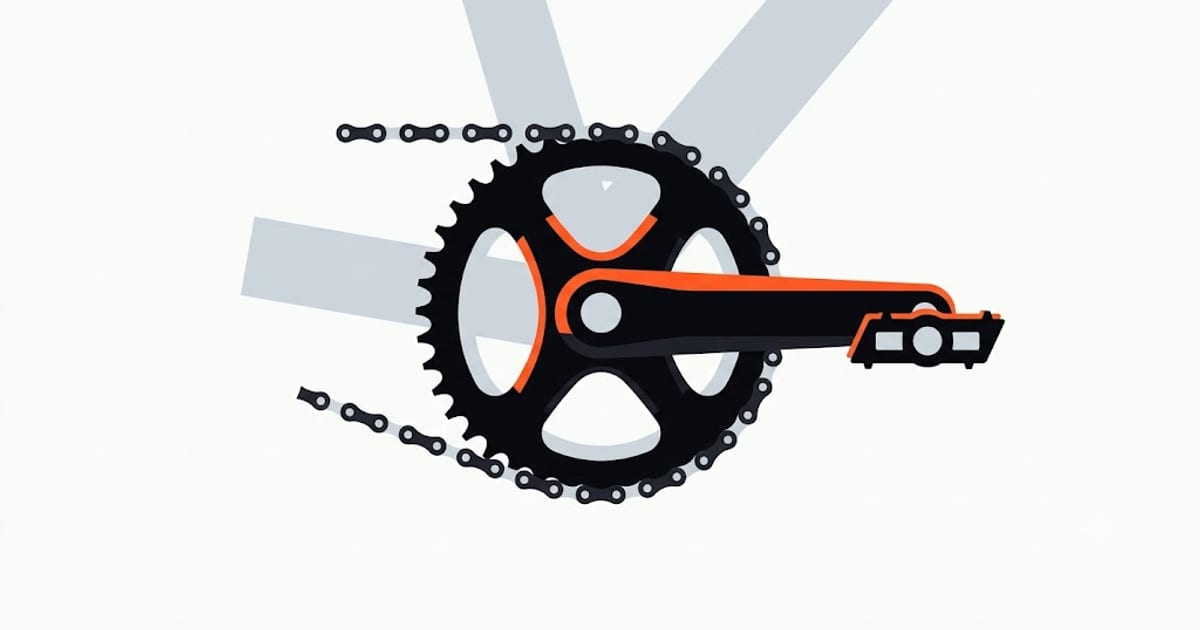 1× or 2×? You Are Choosing Between Range and Step Size, Not Between Simple and Complex
The simplicity argument is real and it is not the trade-off. With one chainring you keep either the range or the fine steps between gears, not both.