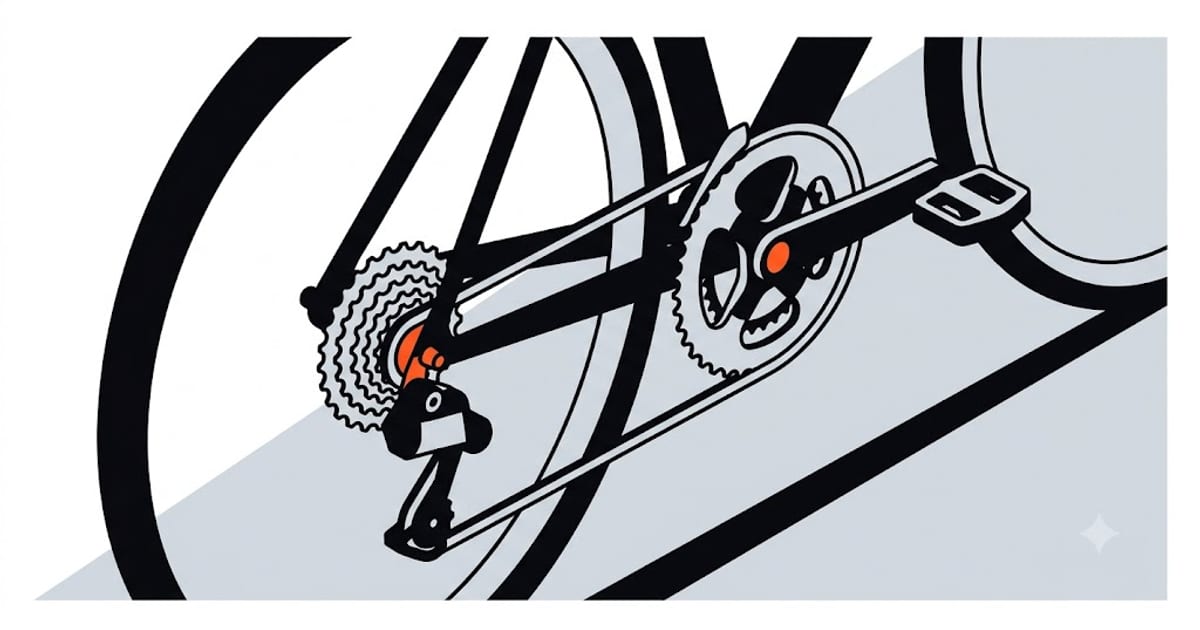
Gearing discussions drift toward top-end ratios. On a climb, the top end is irrelevant — you will never approach it. What decides whether a hill is pleasant or grim is the lowest gear available.
Is your lowest gear low enough
Use gain ratio, which accounts for wheel size and crank length — the reasoning is in bike gear ratios.
| Lowest gain ratio | Suits |
|---|---|
| 2.5+ | flat terrain only |
| 2.0–2.5 | rolling, moderate climbs |
| 1.5–2.0 | sustained steep climbs |
| below 1.5 | loaded touring, very steep, or low cadence riders |
Concretely: a compact 50/34 with an 11–28 cassette gives a lowest ratio of 34 ÷ 28 = 1.21, roughly gain ratio 2.6. That is a flat-terrain gear pretending to be a climbing one, and it is what a great many road bikes ship with.
Change to an 11–34 cassette and 34 ÷ 34 = 1.00, gain ratio about 2.1. Same bike, meaningfully different hill.
The three ways lower
A bigger largest sprocket. The cheapest change — a cassette costs less than any other option and takes minutes. Limited by what the derailleur can wrap, below.
A smaller chainring. Sub-compact cranksets (48/31, 46/30) lower everything by roughly 10%. More expensive, and it lowers the top end too, which on a road bike you may not want.
Both, for genuinely steep or loaded riding.
The derailleur limit
Two specifications constrain you.
Maximum sprocket size — the largest tooth count the derailleur cage can clear. Exceed it and the upper pulley fouls the sprocket.
Total capacity — the sum of the front difference and rear difference the cage can take up. A 50/34 with 11–34 needs 16 + 23 = 39 teeth of capacity. Exceed it and the chain goes slack in the small-small combination.
Both are published. Some derailleurs exceed their stated maximum in practice, occasionally with a longer B-screw or a hanger extender — but it is outside specification and shifting quality suffers.
Cadence, and why lower is not weakness
A lower gear means spinning faster at the same speed. That shifts load from your knees to your cardiovascular system, and it is why experienced riders on long climbs run gears that look absurdly easy.
The cost of gearing too high is not slowness — it is grinding at 50 rpm, which loads knees, burns through the muscular reserve you needed at the top, and turns a climb into damage.
A gear you never use costs nothing. A gear you needed and did not have costs the ride.
Chain length
Fitting a much larger sprocket may need a longer chain. Check with the chain in big-big: it should be taut but not straining the derailleur. Too short there bends the hanger or worse, and the failure happens in one pedal stroke.
FAQ
What gearing do I need for steep hills?
A lowest gain ratio around 2.0 or below for sustained steep climbs, and below 1.5 for loaded touring.
Is it easier to change the cassette or the chainrings?
The cassette, by a wide margin — it is cheaper and takes minutes. Check your derailleur's maximum sprocket size first.
What is derailleur total capacity?
The sum of the front and rear tooth differences the cage can take up. Exceed it and the chain hangs slack in the small-small combination.
Will a bigger cassette need a longer chain?
Often. Check the fit in the big-big combination — taut but not straining the derailleur.
Is spinning a low gear less efficient?
It shifts load from knees to cardiovascular system. On long climbs that is the trade experienced riders deliberately make.