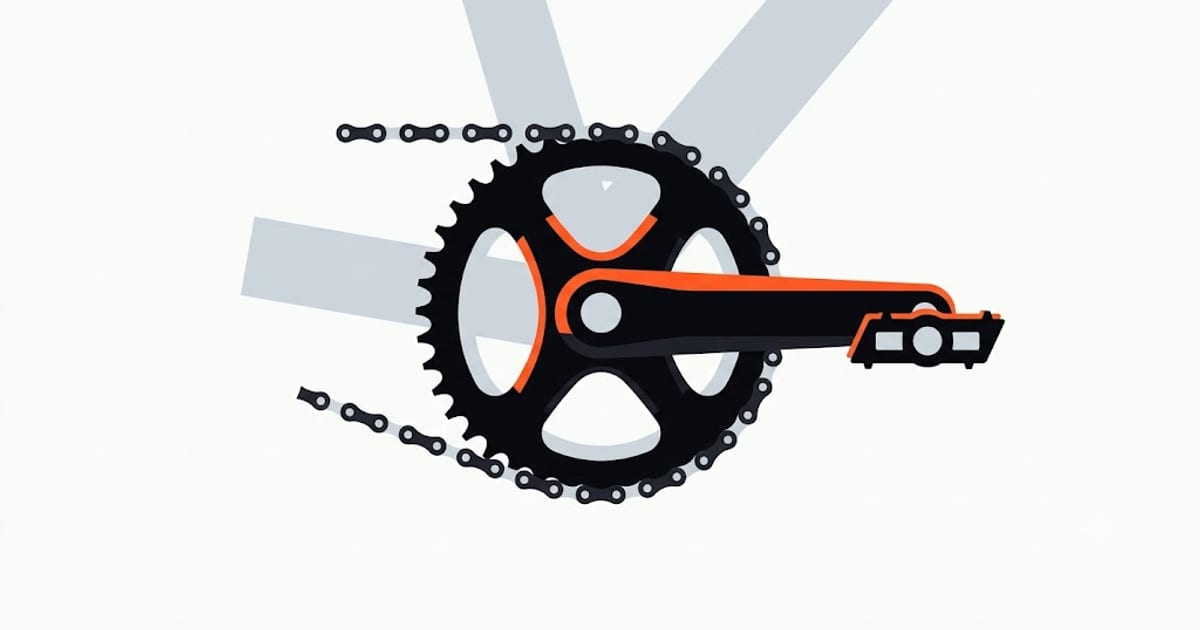
A 2× drivetrain has two chainrings and roughly overlapping gear ranges from each. A 1× has one ring and does everything with the cassette.
The visible difference is the missing front derailleur. The one that changes how the bike rides is arithmetic.
The arithmetic
Total range is the ratio of your biggest gear to your smallest.
2×, 50/34 rings with an 11–34 cassette:
- highest 50 ÷ 11 = 4.55
- lowest 34 ÷ 34 = 1.00
- range 4.55, spread across effectively 15–18 usable gears
1×, 42 T ring with a 10–52 cassette:
- highest 42 ÷ 10 = 4.20
- lowest 42 ÷ 52 = 0.81
- range 5.19, spread across 12 gears
The 1× actually has more range here. It spreads that range over fewer sprockets, so every step between gears is bigger.
Why step size matters
On a climb at threshold, the difference between the right cadence and the wrong one is small. A tight cassette lets you find it. A wide one gives you a gear slightly too hard and one slightly too easy, and you pick whichever you can bear.
This is why road racing stayed on 2× long after mountain biking moved to 1×. Sustained efforts at a precise cadence reward fine steps; technical off-road riding, where cadence varies constantly anyway, does not notice them.
What 1× genuinely buys
Fewer things to adjust. No front derailleur, no front shifter, no front shift cable. One less system to index and one less thing to go out of alignment.
No dropped chains. Narrow-wide chainrings and clutch derailleurs hold the chain far better than a front derailleur setup on rough ground.
Less thinking. One shifter. On technical terrain this is not trivial.
Lighter, slightly — one ring, one derailleur, one shifter and one cable removed.
What it costs
Coarser steps, as above.
Chain angle. With one ring, the chain runs at an extreme angle in the outermost sprockets. Modern drivetrains tolerate it, but it is more wear and more friction than a 2× spending most of its time near-straight.
Very large sprockets need a long-cage derailleur and specific freehub standards — XD or Micro Spline for a 10 T smallest sprocket. See drivetrain compatibility.
Cost. Wide-range 12-speed cassettes are expensive, and they wear like any cassette — see when to replace a chain, because replacing a chain on time is what protects that expensive cassette.
Which to choose
1× — mountain biking, gravel, commuting, anything where terrain varies constantly and simplicity is worth more than precision. Also anyone who never used the front shifter thoughtfully anyway.
2× — road riding, long climbs at steady effort, touring with load, and anyone who cares about holding an exact cadence.
Neither is an upgrade over the other. A 1× conversion on a road bike usually makes it worse for road riding, and a 2× on a technical trail bike is a chain waiting to drop.
FAQ
Is 1x better than 2x?
Neither is better. 1× is simpler and holds the chain better; 2× gives finer steps between gears for the same range.
Does 1x have less range?
Not necessarily — a modern 10–52 cassette has more total range than many 2× setups. It spreads that range over fewer sprockets, so the steps are bigger.
Why do road bikes still use 2x?
Sustained efforts reward being able to hit an exact cadence, and closer-spaced gears make that possible.
Can I convert my 2x to 1x?
Usually, with a narrow-wide chainring and often a new cassette and derailleur. Whether you should depends on whether you value range or step size.
Does 1x wear chains faster?
Somewhat. With one ring the chain runs at more extreme angles in the outer sprockets, which adds friction and wear.