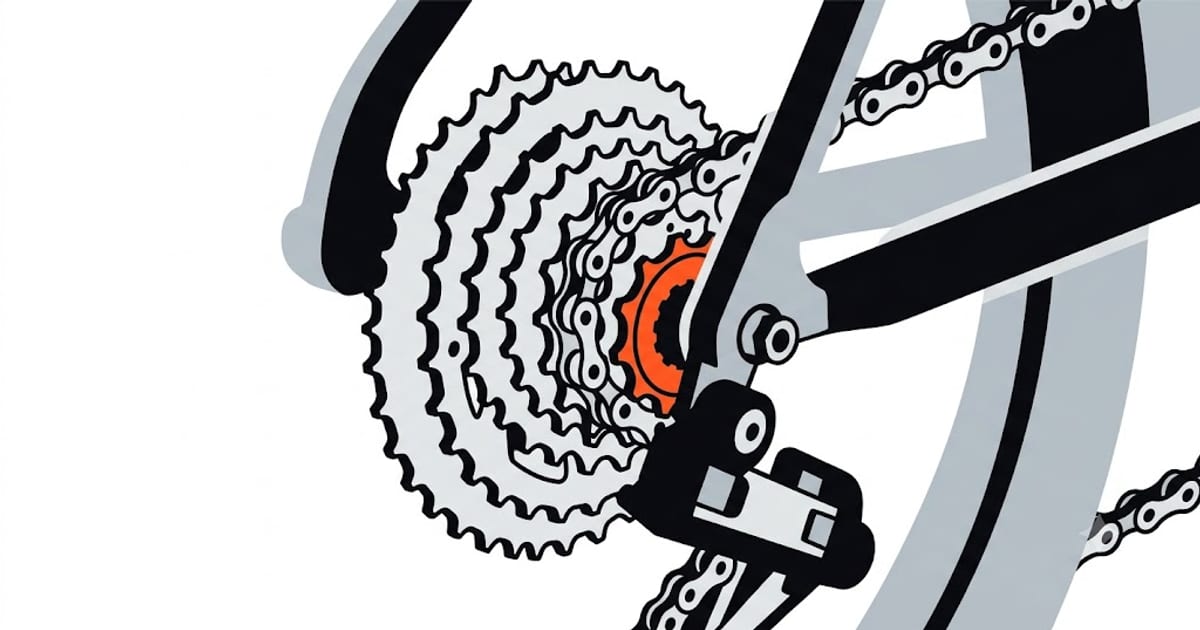
Almost every drivetrain compatibility question reduces to four checks. Three of them are lookups. The fourth is the one that catches people, because the parts physically fit and then do not work.
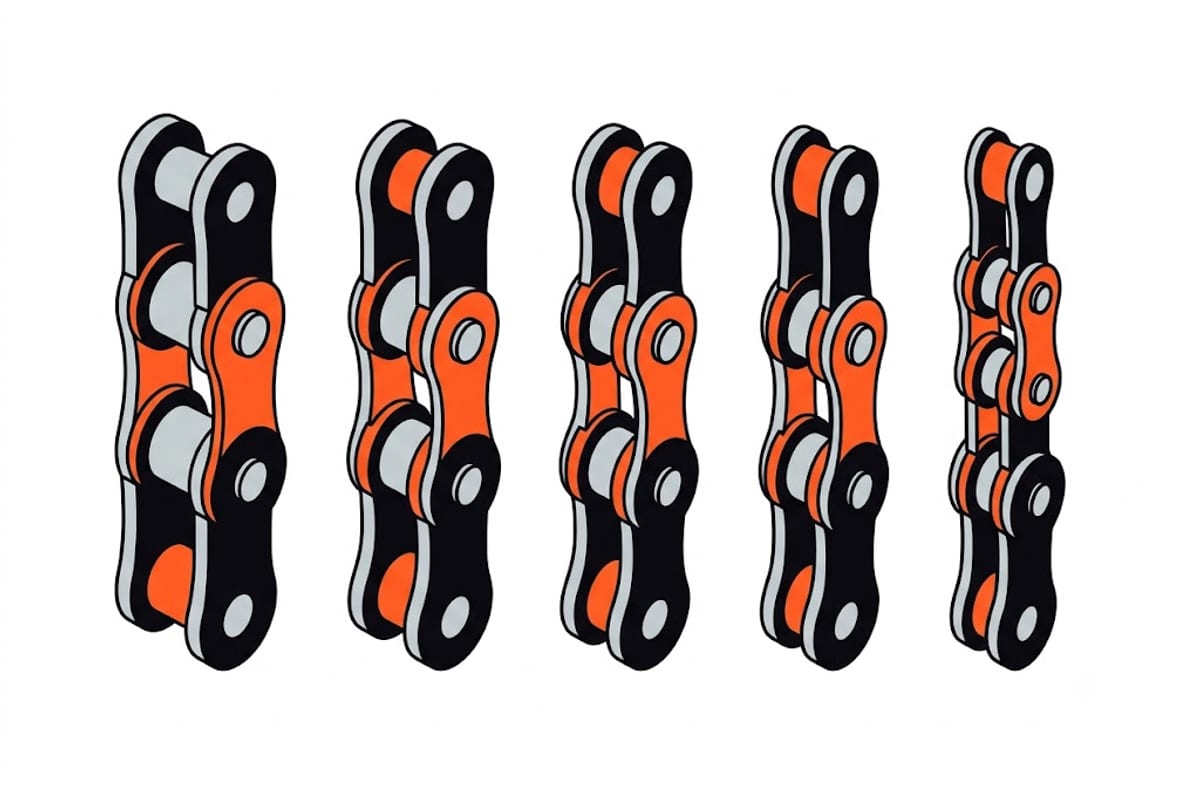
1. Chain width must match the sprocket count
More sprockets in the same space means thinner sprockets and a narrower chain. Approximate outer widths:
| Speeds | Chain outer width |
|---|---|
| 8 | ~7.1 mm |
| 9 | ~6.6–6.8 mm |
| 10 | ~5.9–6.2 mm |
| 11 | ~5.5–5.6 mm |
| 12 | ~5.3 mm |
A chain that is too wide will not drop cleanly between sprockets and shifts badly under load. A chain that is too narrow rides poorly on wider teeth and wears both faster.
This is the one rule with almost no exceptions, and it is independent of brand: an 11-speed chain from any manufacturer works on 11-speed sprockets from any other.
2. The freehub body must accept the cassette
The cassette does not mount to the wheel — it mounts to the freehub body, and there are several incompatible standards:
- Shimano HG — the long-standing default, splined, still the most common.
- SRAM XD / XDR — a threaded interface allowing a 10-tooth smallest sprocket, which HG cannot fit. XD is MTB, XDR is road (1.85 mm longer).
- Shimano Micro Spline — Shimano's answer to XD, also allowing 10 teeth.
A cassette and a freehub body from different standards do not fit at all, in any orientation. This is a hard stop rather than a compromise, and it is usually what "my new cassette will not go on" means.
3. Actuation ratio — the one that fails silently
This is the interesting one. Actuation ratio is how far the derailleur moves per millimeter of cable the shifter pulls, and shifter and derailleur must agree on it.
They are not standardized across brands, or even across a single brand's road and mountain lines. The parts bolt on. The cable connects. And then the derailleur moves the wrong distance per click, so you can index two or three sprockets correctly and never the whole cassette.
The failure looks like a tuning problem, which is why people spend an evening on the barrel adjuster before concluding the combination was never going to work.
The practical rules:
- Shimano road and Shimano MTB are generally not interchangeable at the same speed count.
- Shimano and SRAM 11-speed road are not interchangeable.
- Some combinations do work, and they are known exceptions rather than things to deduce. Look up the specific pair before buying.
4. Chainline
Chainline is the distance from the frame centerline to the chainring — or to the middle of the cassette at the back. When front and rear disagree, the chain runs at a permanent angle: noisy, faster-wearing, and worse shifting at the extremes.
It matters most on 1× drivetrains, where there is no front shifting to mask the problem, and on boost versus non-boost hub spacing where the numbers differ by a few millimeters that you can hear.
What this means in practice
Replacing like with like: check nothing beyond speed count.
Upgrading a cassette within a brand and speed count: check the freehub body.
Mixing brands: check the actuation ratio first, because it is the one that cannot be adjusted around. Everything else either fits or does not, visibly.
Once the drivetrain is settled, the numbers that decide how it rides are covered in bike gear ratios and chain length.
FAQ
Can I use a SRAM chain with a Shimano cassette?
Yes, provided the speed count matches. Chains are compatible across brands at the same speed count; shifters and derailleurs are not.
Will an 11-speed chain work on a 10-speed cassette?
It will run, but poorly. The narrower chain sits differently on wider teeth and accelerates wear on both. Match the chain to the sprocket count.
Why won't my derailleur index across the whole cassette?
Most often a mismatched actuation ratio — the shifter and derailleur come from different families that move different distances per click. No amount of barrel adjustment fixes it.
Can I fit a SRAM cassette to a Shimano freehub?
Only if it is an HG cassette. SRAM's XD and XDR cassettes need an XD/XDR freehub body, which is a different interface entirely.
Does a wider cassette need a different derailleur?
Yes, past a point. Every derailleur has a maximum sprocket size and total capacity. Exceeding it means the cage cannot take up the slack or clear the largest sprocket.