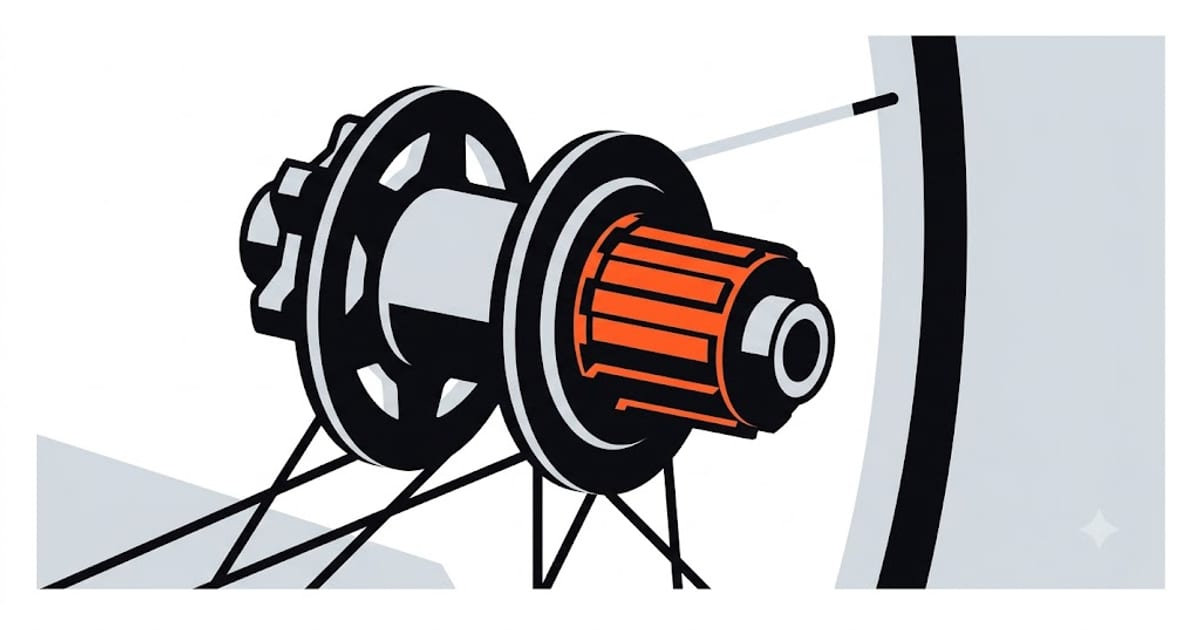
A cassette mounts to the freehub body — the splined or threaded cylinder on the rear hub that carries the ratchet mechanism. Wheel and cassette can both be correct and still not fit each other, because the freehub body between them is a separate standard.
The four in common use
Shimano HG — splined, the long-standing default. Smallest possible sprocket is 11 teeth, because anything smaller cannot clear the splines.
SRAM XD — a threaded interface rather than splined. The smallest sprocket threads directly onto the body, which allows a 10-tooth sprocket. Mountain bike standard.
SRAM XDR — XD, 1.85 mm longer, for road hubs. An XD cassette will not fit an XDR body without a spacer, and an XDR cassette will not fit XD at all. This is the pair people most often confuse, because the names differ by one letter and the parts look identical.
Shimano Micro Spline — Shimano's answer to XD, also allowing 10 teeth. Mountain bike.
Campagnolo N3W is a fifth, on newer Campagnolo hubs.
These do not interchange in any orientation. A mismatch is a hard stop, not a compromise, and it is usually what "my new cassette will not go on" means.
Why a 10-tooth sprocket needs its own standard
An 11-tooth sprocket is already close to the diameter of the splines it sits on. Going to 10 leaves no material for a splined interface to grip.
XD and Micro Spline solve it by moving the load path — the small sprocket threads onto or engages the body differently, so the splines no longer limit the minimum size.
That single tooth matters more than it sounds. Going from 11 to 10 at the small end lets a 1× drivetrain reach the same top gear with a smaller chainring, which lowers every other gear at the same time. It is what makes wide-range 1× setups workable, and it is the subject of 1× against 2×.
Freehub bodies are often replaceable
Good news for anyone with the wrong one: on many hubs the freehub body unbolts and a different standard bolts on. HG to Micro Spline, or HG to XD, is frequently a part swap rather than a new wheel.
Whether yours allows it depends entirely on the hub manufacturer, and the part is hub-specific. Check the hub model before concluding you need a new wheel — it is often the difference between a modest part and a large one.
The 11-speed road spacing problem
An older HG freehub body built for 8–10 speed road cassettes is narrower than an 11-speed road cassette needs.
Two ways this appears:
- A newer hub ships with a body long enough for 11-speed, and fitting a 10-speed cassette requires a 1.85 mm spacer behind it.
- An older hub may not accept 11-speed road at all.
Mountain 11-speed uses the same spacing as 10-speed mountain, so this is a road-specific trap.
What to check before buying a cassette
- Which freehub standard is on the wheel — HG, XD, XDR, Micro Spline, N3W.
- Speed count, matching your shifters and chain.
- Whether a spacer is needed for a 10-speed cassette on an 11-speed road body.
- Derailleur maximum sprocket size, if going to a wider cassette.
Points 2 and 4, along with the actuation ratio question that catches cross-brand builds, are in drivetrain compatibility.
FAQ
What is the difference between XD and XDR?
XDR is 1.85 mm longer, for road hubs. An XD cassette fits an XDR body with a spacer; an XDR cassette does not fit XD.
Can I fit a SRAM cassette on a Shimano freehub?
Only if it is an HG cassette. SRAM's XD and XDR cassettes need an XD or XDR body.
Why can't a normal freehub take a 10-tooth sprocket?
The splines are already close to the sprocket diameter at 11 teeth. Going smaller leaves no material for a splined interface, so XD and Micro Spline change how the small sprocket engages.
Can I change my freehub body to a different standard?
Often yes — many hubs accept a replacement body, and it is hub-specific. Check the hub manufacturer before buying a new wheel.
Do I need a spacer for a 10-speed cassette?
On an 11-speed road freehub body, yes — a 1.85 mm spacer behind the cassette. Mountain drivetrains do not have this issue.