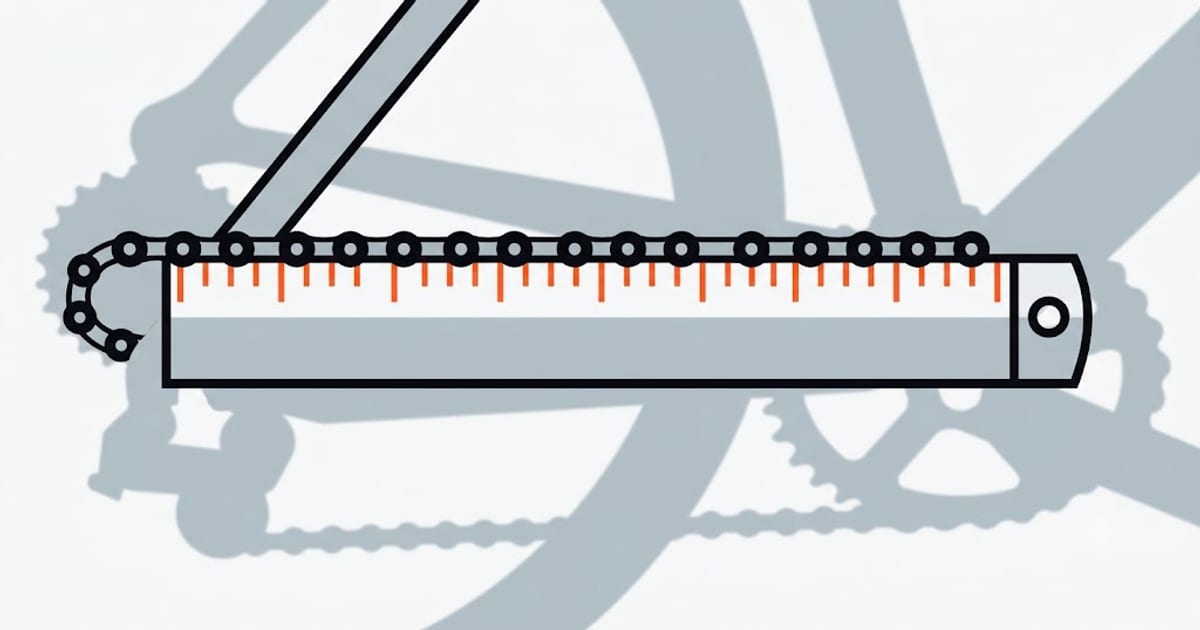
A new chain has exactly one inch between rivet centres. Twelve links measure twelve inches. Everything after that is wear.
The ruler method
- Put the chain on the large chainring so the top run is under tension.
- Lay a steel ruler along it, zero on the centre of a rivet.
- Read at the twelfth inch mark.
| Reading at 12 in | Elongation | Action |
|---|---|---|
| 12 in exactly | new | — |
| 12 1/16 in | 0.5% | replace on 11 and 12-speed |
| 12 1/8 in | 0.75% | replace on 10-speed and older |
| beyond | worn out | check the cassette too |
Use a steel ruler. A tape measure flexes and a plastic ruler is not accurate enough over twelve inches for a measurement where a sixteenth decides the answer.
The thresholds and why they differ by speed count are in when to replace a chain.
Why gauges disagree
Common drop-in wear gauges have a pin at each end. They drop into the gaps between rollers, so the reading includes roller wear as well as pin wear.
A ruler measures only pitch — the distance between rivet centres.
The thresholds published by manufacturers are defined against pitch. So a gauge that also picks up roller wear reads pessimistic: it can indicate 0.75% on a chain a ruler calls 0.5%.
Neither is wrong. If your gauge says replace and a ruler disagrees, the ruler is measuring the thing the thresholds were written about.
Better gauges use a single-ended design that isolates pitch, and those agree closely with a ruler. If you own one, it is the fastest correct tool.
Measure in several places
Chain wear is not uniform. The links that spend most time under high load in the gears you use most wear faster than the rest.
Measure in three or four places around the chain and take the worst reading. A chain that measures 0.4% in one place and 0.6% in another is a 0.6% chain — the worn section is what skips.
Measure it clean
Grit packed into the rollers can hold them apart and inflate a gauge reading. Wipe the chain first. A ruler is less affected, since it reads rivet centres rather than roller gaps.
How often
Every few hundred kilometres, more often in wet and gritty conditions.
Mileage is not a substitute for measuring. Reported chain life ranges from under 1,500 km to well over 5,000, and the spread is dominated by conditions rather than by the chain — so mileage is a reminder to check, not an answer.
What to do with a worn chain
Replace it. A chain is the cheapest wearing part of the drivetrain, and running it past the threshold reshapes the cassette teeth to match the worn chain. Then the new chain skips on the old cassette and you replace both.
Replace chains on time and one cassette typically outlasts two or three of them. This is the entire economic argument for owning a ruler.
FAQ
How do I measure bike chain wear without a tool?
A steel ruler. Twelve links measure twelve inches when new; replace at 12 1/16 inches for 11 and 12-speed.
Why does my chain checker say worse than my ruler?
Most drop-in gauges include roller wear as well as pitch. The published thresholds are defined against pitch, which is what a ruler measures.
Where should I measure the chain?
Three or four places around it, and take the worst reading. Wear is not uniform.
How often should I check chain wear?
Every few hundred kilometres, more often in wet or gritty conditions. Chain life varies too much for mileage alone to be reliable.
Should the chain be under tension when measuring?
Yes. Put it on the large chainring so the top run is taut, or the reading is not repeatable.