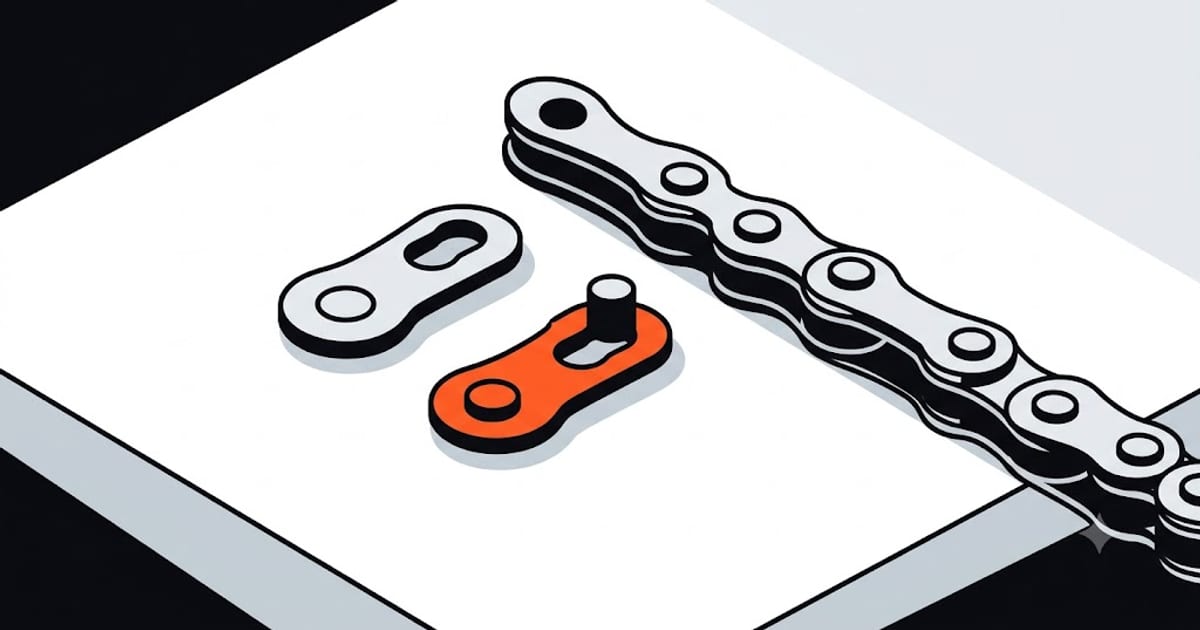
Two ways to close a chain.
Connecting pin — a special rivet pressed through with a chain tool. Shimano's traditional method. Strong, permanent, and removing the chain means breaking it somewhere else next time.
Quick link — two plates that snap together under chain tension. Fitted by hand, removed with pliers or a cheap dedicated tool. Almost universal now outside Shimano's own chains.
Reusable or not
8, 9 and 10-speed links are generally rated reusable, and in practice most are.
11 and 12-speed links are usually rated single-use by their manufacturers.
The reason is dimensional. Narrower chains mean thinner plates and less material in the locking feature. Each opening deforms it slightly, and after a few cycles the retention margin — the thing stopping the link opening under load — is gone.
Plenty of people reuse them regardless and report no trouble. The failure mode is worth understanding before deciding: a chain that separates under load usually does so during a hard effort, and the rider goes over the bars or into the stem. It is one of the few bicycle component failures that reliably causes injury.
Quick links cost very little. Carry two and treat them as consumable.
Direction matters on some links
Several 12-speed quick links are directional, with an arrow indicating which way they must face relative to chain travel.
Fitted backwards they can work loose. The arrow is small and easy to miss, and a link installed the wrong way often behaves normally for a while — which is the worst kind of fault.
Check the packaging. If there is an arrow, it matters.
Opening one without a tool
The dedicated pliers are cheap and worth carrying. Without them:
With a short piece of cable or a spoke — bend a spoke into a U, hook the two ends into the link's outer holes, and squeeze the ends together while pushing the plates toward each other.
By hand — put the link at the top of the chain run, hold the chain either side, and push the two halves toward one another while pressing down. Works on some links and not others, and it works better on worn ones than on new.
Never with a screwdriver levered between the plates. That bends the plates and ruins the link, and it slips.
Which chain works with which
Chains and quick links must match the speed count. An 11-speed link on a 12-speed chain is the wrong width and the wrong plate thickness.
They do not need to match the brand. A SRAM link on a Shimano chain of the same speed count is standard practice, and for Shimano 12-speed road it is a common alternative to buying the proprietary connecting pin every time.
Chain speed widths, and why they differ, are in drivetrain compatibility. When to replace the chain at all is in measuring chain wear.
FAQ
Are bike chain quick links reusable?
8 to 10-speed links generally yes. Most 11 and 12-speed links are rated single-use by their manufacturers because the narrower plates lose retention margin with each opening.
Can I use a SRAM quick link on a Shimano chain?
Yes, provided the speed count matches. Brand does not need to match.
Does a quick link have a direction?
Some 12-speed links do, marked with an arrow. Fitted backwards they can work loose.
How do I open a quick link without the tool?
A bent spoke hooked into the outer holes works, as does hand pressure with the link at the top of the chain run. Never lever a screwdriver between the plates.
Is a quick link as strong as a connecting pin?
Yes when correctly fitted and within its rated reuse. The failure risk comes from reusing worn single-use links, not from the design.