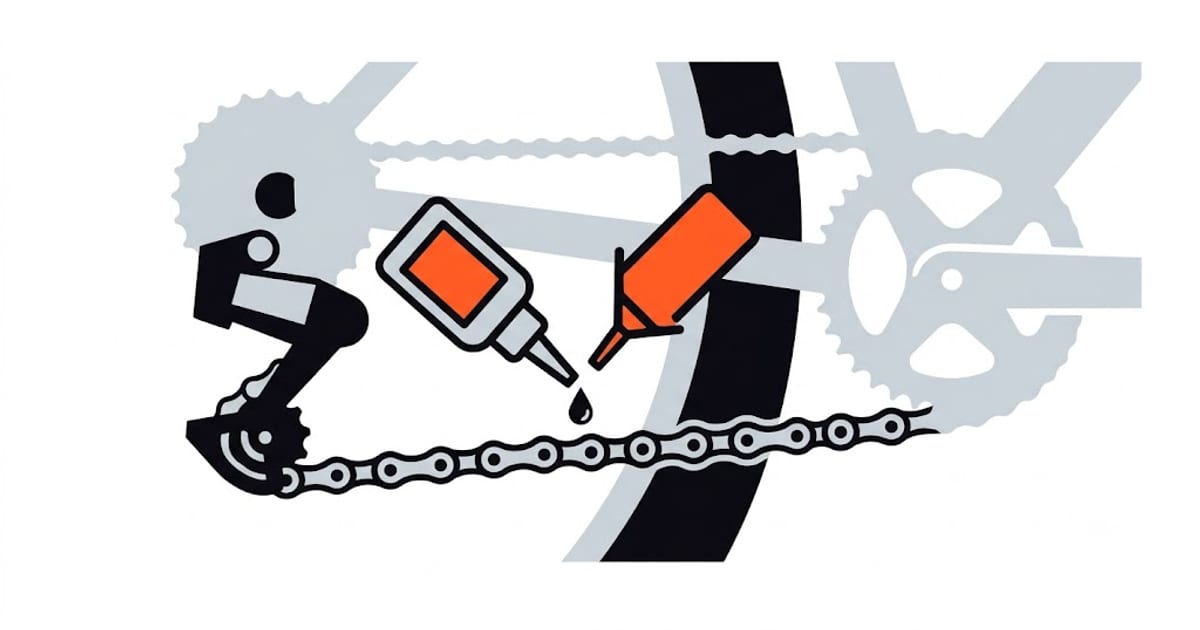
Chain wear is abrasion. Grit works into the rollers and grinds the pins, and the lubricant's real job is to keep that grit out as much as to reduce friction.
That reframes the choice: the lubricant that attracts the least dirt in your conditions is usually the one that lasts longest, regardless of what it claims about friction.
The three types
| Wet | Dry | Wax | |
|---|---|---|---|
| Base | oil | thin carrier, evaporates | paraffin |
| Attracts dirt | heavily | moderately | very little |
| Lasts in rain | well | poorly | moderately |
| Reapply | ~200–300 km | ~100–150 km | ~200–300 km |
| Cleanliness | poor | good | excellent |
| Effort | low | low | high |
Wet lube is oil that stays on the chain. Excellent in rain and winter, and it holds every particle of road grit it meets. Chains and legs both end up black.
Dry lube carries a lubricant in a solvent that evaporates, leaving a thin film. Much cleaner. Washes off in rain.
Wax — immersion waxing, where the chain is stripped and dipped in molten paraffin — is the cleanest and lowest-friction option. Dirt does not stick to it; it flakes off with the wax. The cost is process: the chain must be stripped of factory grease first, and re-waxing means removing the chain and melting a pot.
Application is where it goes wrong
Apply to a clean chain. Adding lubricant over an already gritty chain suspends the grit and carries it into the rollers. That is worse than a dry chain — it is grinding paste with a delivery system.
One drop per roller, on the lower run, rotating the cranks backwards. Not a stream along the chain, and not on the sprockets.
Let it penetrate, a few minutes.
Then wipe the outside thoroughly with a rag. This is the step people skip, and it is the most important one.
Lubricant belongs inside the rollers, where the moving surfaces are. Lubricant on the outside of the plates does nothing except collect grit and hold it against the sprockets. A properly lubricated chain looks almost dry.
How often
Judge by sound and feel rather than by distance. A chain that has started to sound dry — a light rustling that was not there before — needs attention regardless of how recently it was lubricated.
Always re-lubricate after riding in rain, and after any wash. Water displaces lubricant from the rollers whether or not the chain looks wet.
Cleaning
Light — wipe with a dry rag through the chain while backpedalling. Adequate between most rides.
Thorough — degreaser and a chain-cleaning tool, then dry completely before re-lubricating. Every few weeks in bad conditions.
Full strip — remove the chain and soak. Necessary before waxing, and worthwhile before switching lubricant types.
Do not use a strong solvent repeatedly on a chain you intend to keep — some strip lubricant from inside the rollers, where it cannot easily be replaced.
Does the choice affect chain life
Less than conditions and cleaning do. Riding in grit and wet dominates chain life; the spread between lubricants is much smaller than the spread between a maintained chain and a neglected one.
Which is why measuring matters more than product choice — see how to measure chain wear.
FAQ
Should I use wet or dry chain lube?
Wet for rain and winter, dry for dry conditions. Wet lasts longer in bad weather but attracts far more grit.
Is chain wax worth the effort?
It is the cleanest and lowest-friction option, and it needs the chain stripped and dipped in molten paraffin. Worth it if drivetrain cleanliness matters to you.
How often should I lube my chain?
When it starts to sound dry, and always after riding in rain or washing the bike. Roughly every 100–300 km depending on the lubricant.
Should I wipe the chain after lubing?
Yes, thoroughly. Lubricant belongs inside the rollers; on the outside it only collects grit.
Can I apply lube to a dirty chain?
No. It suspends the grit and carries it into the rollers, which accelerates wear rather than reducing it.