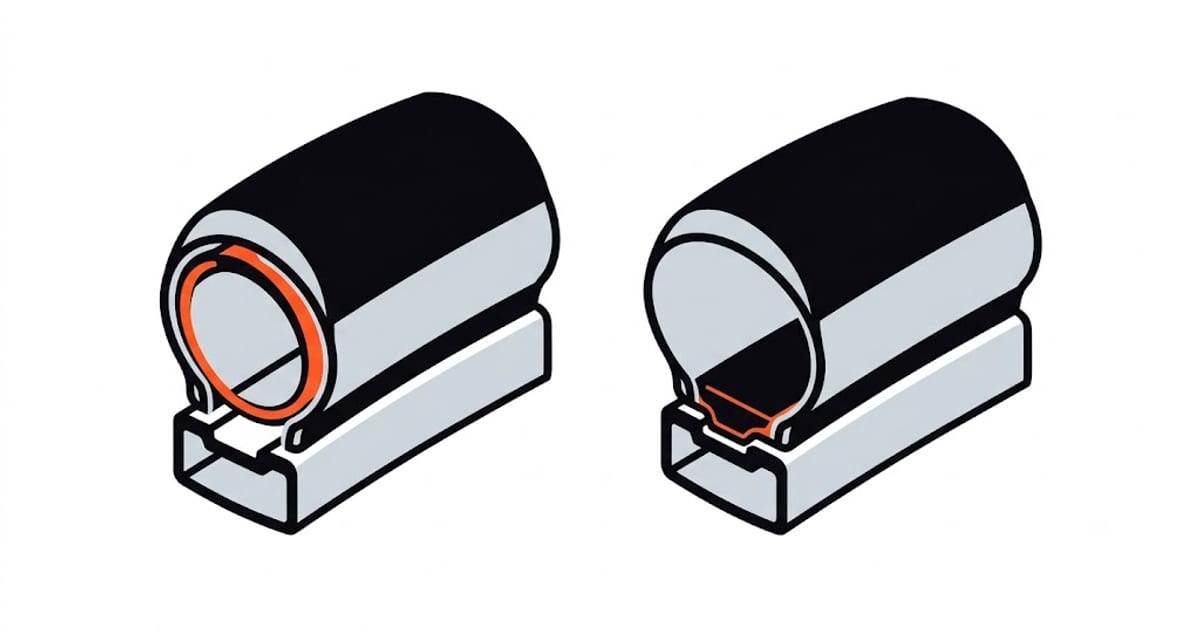
The advice you will hear is that tubeless lets you run about 10 psi less. That is a reasonable rule of thumb attached to a wrong explanation, and the explanation matters because it tells you when the rule does not hold.
What does not change
The tire drop your tire wants is unchanged. Tire drop is set by the casing, the load and the pressure. Removing the tube does not alter how much the casing deflects under a given load at a given pressure, so the 15 % target from the pressure method is the same number tubed or tubeless.
If you were running the correct pressure with tubes and you switch to tubeless with everything else identical, your optimal pressure for rolling resistance on smooth ground barely moves. Any change is small, from the tube's own hysteresis losses.
So why does everyone run lower?
What changes: the floor
With an inner tube, going too low risks a pinch flat. The tube gets crushed between the rim edge and whatever you just hit, and it punctures in the characteristic two-hole pattern.
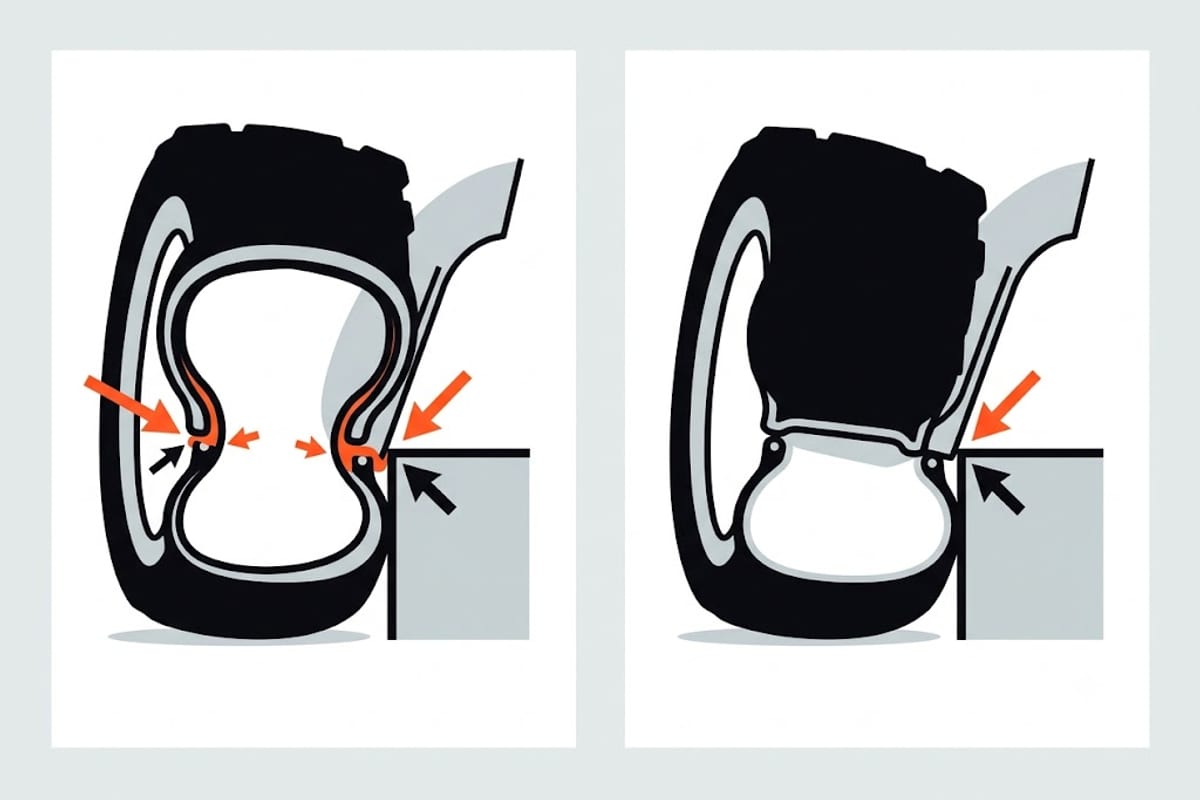
That risk set a practical minimum pressure that had nothing whatsoever to do with rolling resistance. Riders were not running higher pressures because they were faster — they were running higher pressures because the alternative was walking home.
Tubeless removes that specific failure. There is no tube to pinch. The pressures that were always theoretically better become usable.
This is why the benefit is largest exactly where the road-derived optimum was already low and the surface was already rough: gravel and mountain biking gain enormously, smooth-road riding gains very little.
The new floor, and it is a harder one
Tubeless does not remove the bottom of the range. It replaces one failure with two others.
Burping. At low pressure and high cornering load, the casing can deform enough to break its seal against the rim bed for an instant, venting air. You lose several psi at once, mid-corner. Modern hookless and tubeless-specific rims resist this well; older or marginal rim-tire combinations do not.
Rim damage. Without a tube to absorb part of the impact, a hard square-edged strike puts the rim edge directly against the obstacle through a thin layer of casing. On carbon rims this is expensive. On alloy it is a dent that may stop the tire sealing afterwards.
So the practical floor moves down, but it does not disappear, and the consequence of crossing it changes from a repairable puncture to a possibly unrepairable wheel.
How much lower, in practice
Rather than a fixed 10 psi, scale it to how much the pinch-flat risk was constraining you in the first place:
| Riding | Reduction from the tubed figure | Why |
|---|---|---|
| Smooth road, 25–28 mm | 0–5 psi | Pinch flats were never the binding constraint |
| Mixed road, 30–32 mm | 5–8 psi | Some constraint, mostly on bad surfaces |
| Gravel, 38–45 mm | 10–15 % | Pinch flat risk was the main thing holding pressure up |
| MTB, 2.1–2.6 in | 15–20 % | The whole point of tubeless at these widths |
Notice the units change. At road pressures a fixed psi figure works because the numbers are large. At gravel and MTB pressures, 10 psi is a third of the total — use a percentage.
Finding your floor
The tuning signal is the same one that matters on gravel: rim strikes.
- Start at your tubed pressure minus the reduction above.
- Ride a route you know that includes the roughest surface you actually use.
- Count the impacts where you feel the rim through the tire.
- One on a long ride is about right. More than that, add 2 psi. None at all over several rides on rough ground, drop 2 psi.
Do this per-wheel. The front and rear see different loads and different impacts, and a front rim strike matters more.
Things that change your floor
- Rim internal width. A wider rim supports the casing better at low pressure, resisting both burping and squirm. Moving from a 19 mm to a 25 mm internal rim genuinely lets you run lower.
- Casing inserts. A foam insert sits inside the tire and takes the impact before the rim does. It lets you go several psi lower and turns a rim-destroying hit into a survivable one — at the cost of weight, fitting difficulty, and a slower rolling tire.
- Sealant volume. Too little sealant and small punctures do not seal; too much is dead weight sloshing around. Follow the sealant manufacturer's figure for your tire volume, and top up on a schedule rather than when you get a flat.
- Tire casing. A supple, thin casing deforms more at a given pressure, so it reaches its floor sooner than a stiff reinforced one at the same width.
When tubeless does not help
If you are running 28 mm tires on good tarmac at 60 psi, tubeless will not make you faster. Your pressure is already set by rolling resistance rather than by pinch-flat fear, so removing the tube removes a constraint that was not binding. You still get puncture sealing, which is worth having — just do not expect the pressure to change much.
The pressure benefit is real, and it is concentrated at gravel and trail widths.
FAQ
How much lower should tubeless tire pressure be?
Scale it to the discipline rather than using a fixed figure: 0–5 psi lower on smooth road, 10–15 % lower on gravel, and 15–20 % lower for mountain biking. The benefit is largest where pinch flats were the thing keeping your pressure high.
Does tubeless actually roll faster?
Slightly, from removing the tube's own energy losses, but the meaningful gain is indirect: it lets you use lower pressures that were always faster on rough ground but were unsafe with a tube in the tire.
What is burping and how do I avoid it?
Burping is the casing momentarily unseating from the rim under high cornering load at low pressure, venting air. Avoid it with a rim and tire designed for tubeless, adequate rim internal width, and by not running below your tested floor.
Can I run any pressure I want without a tube?
No. Tubeless removes pinch flats but introduces rim damage and burping as the new bottom limits, and a dented rim is a worse outcome than a punctured tube. Find your floor by counting rim strikes on rough ground.
Do I need inserts to run low pressure?
Not usually, but they raise your floor's safety margin. An insert absorbs a square-edged impact before the rim does, letting you drop a few more psi and turning a potential rim-destroying hit into a survivable one.