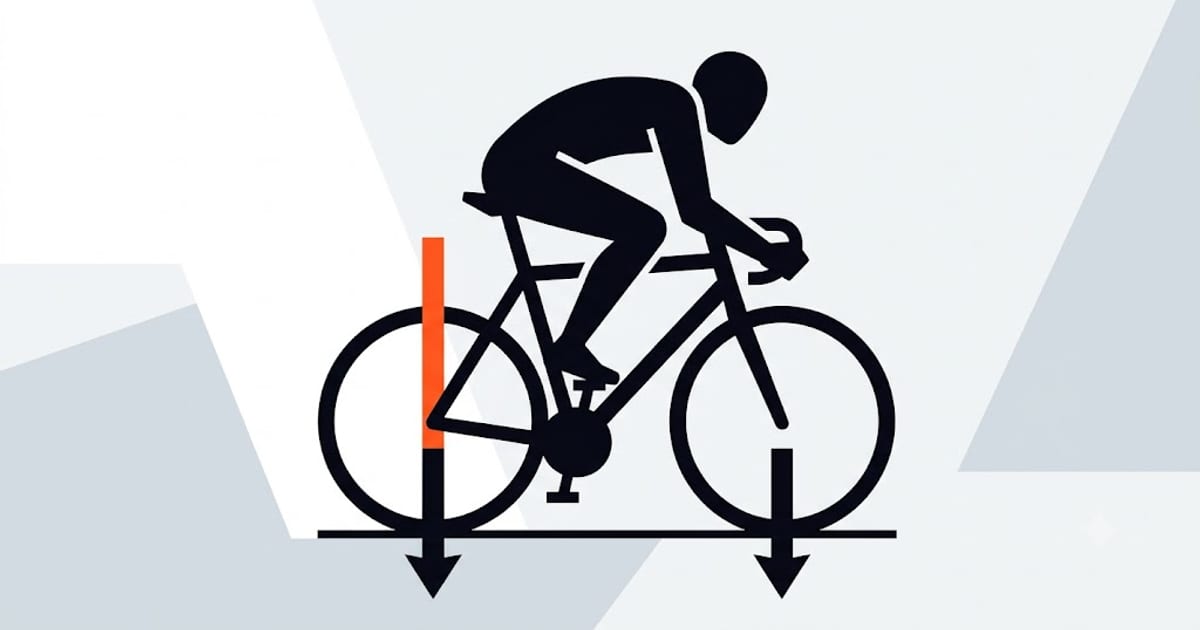
Every road tire pressure chart you have seen asks for your weight and gives you a number. Two things are wrong with that: it usually means your body weight rather than the weight the wheel carries, and it gives one figure for two wheels that carry different loads.
This chart fixes both. Find your total weight — you, the bike, and everything on it — and read across to your measured tire width.
The chart
| Total weight | 25 mm | 28 mm | 30 mm | 32 mm |
|---|---|---|---|---|
| 60 kg | 52 / 64 | 43 / 52 | 38 / 47 | 34 / 42 |
| 65 kg | 56 / 69 | 47 / 57 | 41 / 51 | 37 / 45 |
| 70 kg | 61 / 74 | 50 / 61 | 45 / 54 | 40 / 49 |
| 75 kg | 65 / 80 | 54 / 66 | 48 / 58 | 43 / 52 |
| 80 kg | 69 / 85 | 57 / 70 | 51 / 62 | 46 / 56 |
| 85 kg | 74 / 90 | 61 / 74 | 54 / 66 | 48 / 59 |
| 90 kg | 78 / 95 | 64 / 79 | 57 / 70 | 51 / 63 |
| 95 kg | 82 / 101 | 68 / 83 | 60 / 74 | 54 / 66 |
| 100 kg | 87 / 106 | 72 / 87 | 64 / 78 | 57 / 70 |
| 110 kg | 95 / 117 | 79 / 96 | 70 / 86 | 63 / 77 |
Values in psi, given as front / rear. Assumes a 45/55 weight split and targets 15 % tire drop — see the method and the formula behind it.
An 80 kg rider on an 8 kg bike carrying 2 kg of bottles and tools is in the 90 kg row, not the 80 kg row. That difference is worth about 4 psi.
Why the two numbers differ
In a normal road riding position the rear wheel carries roughly 55 % of the total and the front about 45 %. Same tire, different load, so different pressure to reach the same tire drop.
The gap is consistent: the rear wants about 20 % more pressure than the front. Running them equal means you have one tire too hard and one too soft, and you feel it as a bike that either understeers on rough corners or hammers your hands on rough straights, depending on which way you split the difference.
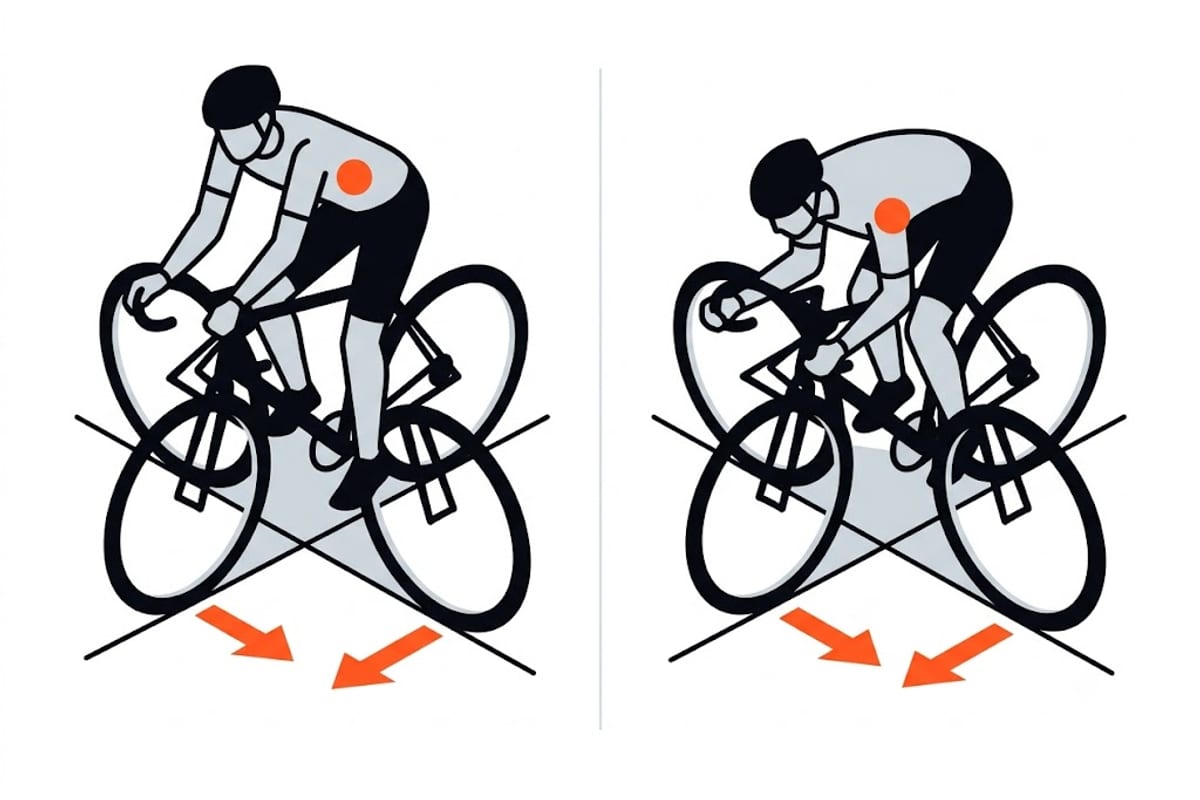
The 45/55 split is an average across a normal day's riding. It shifts:
- Down on the drops — more weight forward, split moves toward 48/52.
- Sitting up on the tops — more weight back, toward 42/58.
- Saddlebag or seatpack — further back again.
- Handlebar bag or aero extensions — forward.
None of these are worth re-inflating for. They are worth knowing if you have made a permanent change, like fitting a large seatpack for long rides.
Measure the tire, do not trust the label
A tire marked 28 mm rarely measures 28 mm. Casing width depends on the internal width of the rim, and rims have grown: the same tire on a 21 mm internal rim measures around 2 mm wider than it did on the 15 mm rims that were standard when tire labelling conventions were set.
Take a caliper to the inflated tire and use the column that matches what you measure. If your 28 mm tires measure 30 mm, you are entitled to run around 5 psi less than the label would suggest.
This is not a rounding detail. Because pressure scales with roughly the 1.7th power of width, that 2 mm is worth more than 6 kg of rider weight.
What the chart assumes, and when to leave it
The 15 % tire drop target comes from Frank Berto's measurements and Jan Heine's rolling resistance testing, and it describes the point where a tire stops getting faster with more pressure. It assumes reasonable tarmac.
Adjust down from the chart when:
- The road surface is genuinely bad. On chipseal or broken tarmac, energy lost to the bike and rider bouncing exceeds what is saved in the casing. Drop 5–10 % and you will usually go faster, not slower.
- You are running tubeless. The pinch-flat risk that set the practical floor for tubed tires is gone. See tubeless tire pressure.
- It is wet. A slightly larger contact patch is worth more than the marginal rolling resistance.
Adjust up from the chart when:
- You are riding on a track or genuinely smooth surface, where there is nothing for the casing to absorb.
- You are near the tire's load limit — a heavily loaded touring bike on narrow tires is the case Berto specifically warned about, where narrow tires need very high pressures and a wider tire is simply the better answer.
A sanity check on the numbers
If the chart tells you to run 117 psi, that is a signal, not an instruction. It means your tires are too narrow for the load they are carrying. A 110 kg system on 25 mm tires genuinely does need that pressure to avoid bottoming out — which is exactly why nobody rides that combination any more.
The same rider on 32 mm tires runs 63 / 77 psi and gets a faster, more comfortable and safer bike. When the chart returns an uncomfortable number, the answer is usually a wider tire rather than a different pressure.
FAQ
What pressure should road bike tires be?
It depends on your total rider-plus-bike weight and your measured tire width. For a 75 kg total on 28 mm tires the chart gives 54 psi front and 66 psi rear; for the same rider on 25 mm tires, 65 and 80 psi.
Should the rear tire have more pressure than the front?
Yes, by about 20 %. The rear wheel carries roughly 55 % of the total load against the front's 45 %, so it needs proportionally more pressure to reach the same tire drop.
Is 100 psi too high for road tires?
For most riders on modern 28 mm or wider tires, yes. The chart only reaches 100 psi for heavy total weights on narrow 25 mm tires. If you are running 100 psi on 28s you are almost certainly over-inflated.
Do I include the bike's weight in the chart?
Yes. Use the total of rider, bike, bottles, tools and any bags. That is typically 8–12 kg more than your body weight, which is worth several psi.
Why does my new bike need lower pressure than my old one?
Almost certainly wider rims. Modern rims measure tires wider than older ones did, so the same labelled tire now needs less pressure. Measure with a caliper rather than reading the sidewall.