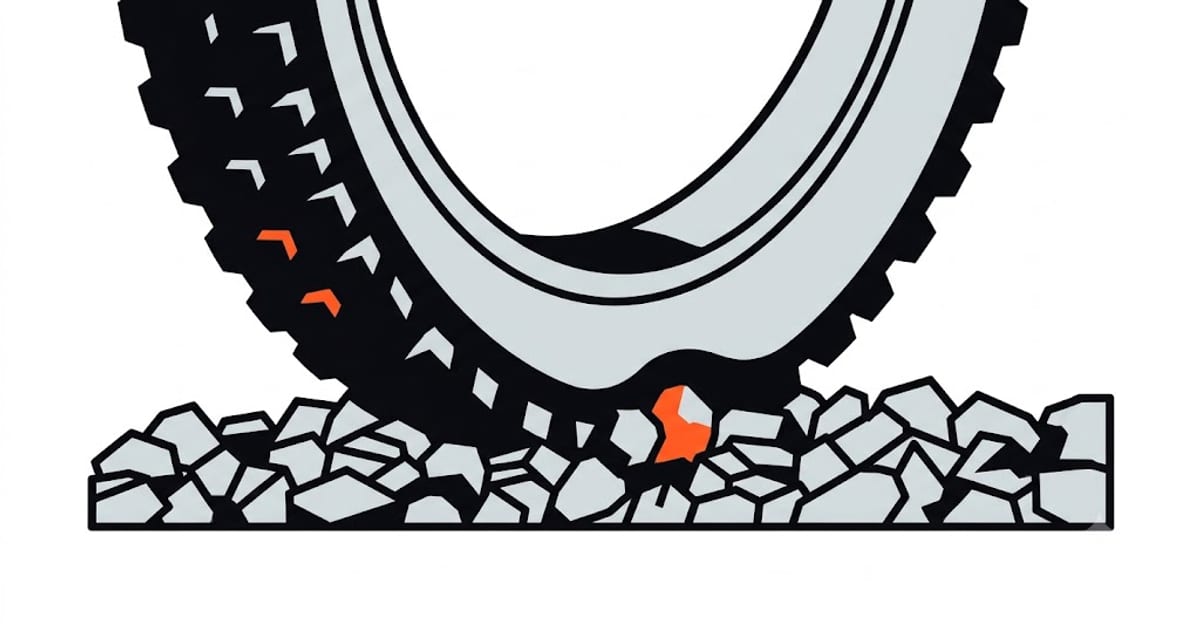
Start with the number the road method gives you, then understand why gravel is the one case where you should deliberately ignore it.
The table
Find your wheel load — total rider-plus-bike weight split roughly 45 % front and 55 % rear — then read across to your measured tire width.
| Wheel load | 38 mm | 40 mm | 42 mm | 45 mm | 50 mm |
|---|---|---|---|---|---|
| 30 kg | 28 → 24 | 26 → 22 | 24 → 20 | 21 → 18 | 18 → 15 |
| 35 kg | 33 → 28 | 30 → 26 | 28 → 24 | 25 → 21 | 21 → 18 |
| 40 kg | 38 → 32 | 35 → 30 | 32 → 27 | 28 → 24 | 24 → 20 |
| 45 kg | 43 → 37 | 39 → 33 | 36 → 31 | 32 → 27 | 27 → 23 |
| 50 kg | 47 → 40 | 43 → 37 | 40 → 34 | 36 → 31 | 30 → 26 |
| 55 kg | 52 → 44 | 48 → 41 | 44 → 37 | 39 → 33 | 33 → 28 |
Values in psi. The first number is the 15 % tire drop pressure from the road method. The second is a starting point for genuine gravel, about 15 % lower.
An 80 kg rider on a 10 kg bike with 2 kg of kit is 92 kg total: 41 kg front, 51 kg rear. On measured 42 mm tires that is a baseline of 33 / 41 psi, and a gravel starting point of 28 / 35 psi.
Why lower, and why it is not about comfort
The 15 % tire drop target identifies the pressure where a tire stops rolling faster as you add pressure. It was established on smooth surfaces, where the only thing absorbing energy is the tire casing flexing.
On rough ground a second energy sink appears, and it is much larger: the bike and the rider being moved vertically.
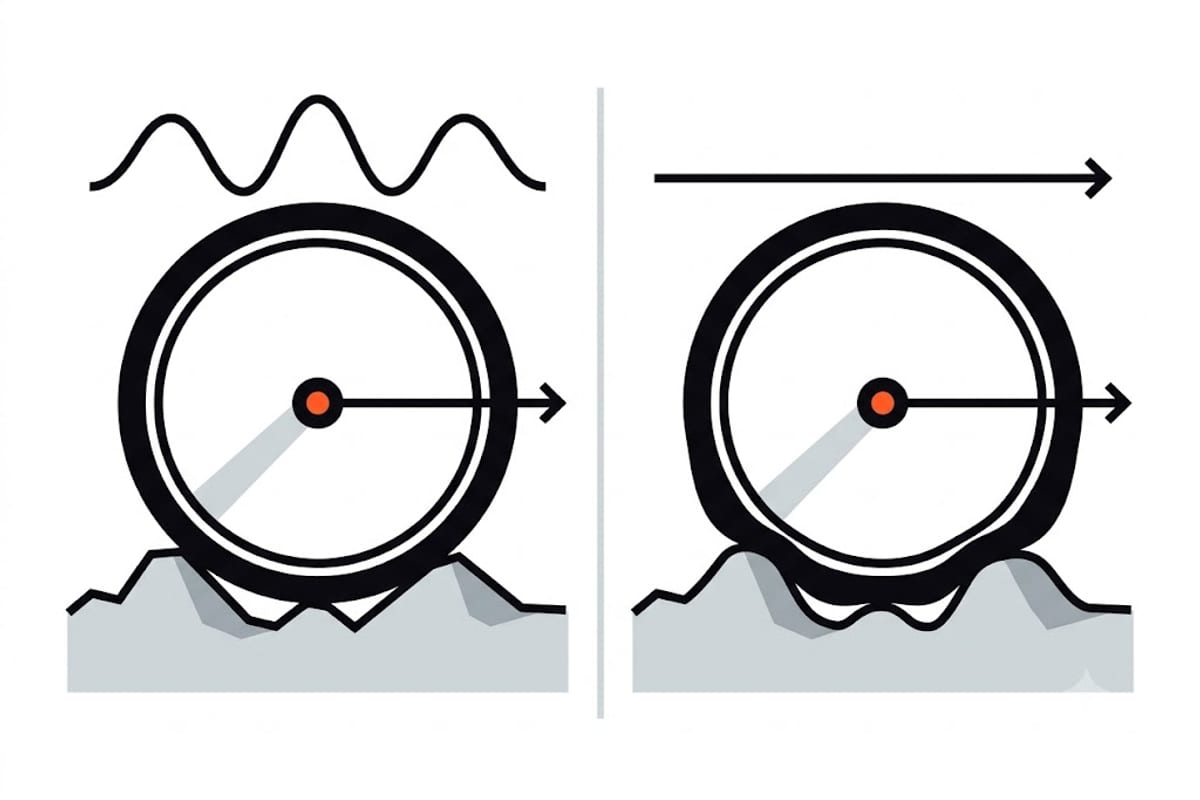
A hard tire rides over the top of every stone, which means lifting the whole bike and rider a few millimetres and letting them drop again, thousands of times per kilometre. A softer tire deforms around the stone and the axle travels nearly straight. The energy that goes into deforming the casing is real, but it is far less than the energy that goes into repeatedly lifting 90 kg of bike and rider.
This is why the fastest gravel pressure is lower than the fastest road pressure for the same tire and rider, and why "lower pressure is more comfortable but slower" is exactly backwards off tarmac. Comfort and speed point the same direction here.
How much lower
The 15 % reduction in the table is a starting point, not a measurement. The right figure depends on how rough the surface actually is, and the honest answer is that you find it by riding:
- Hardpack, smooth dirt roads, light gravel — 5–10 % below baseline. The surface is barely rougher than bad tarmac.
- Typical loose gravel, mixed surface rides — 10–15 % below. This is what the table's second column assumes.
- Chunky, rocky, washboard, or extended rough sectors — 15–25 % below, and be honest about whether your tires are wide enough.
Two hard limits sit underneath all of this:
- Rim strikes. If you feel the rim hit through the tire on a square-edged impact, you are below your floor for that tire and that terrain. One strike on a long ride is roughly right; several is too low.
- Tire roll in corners. If the tire squirms or feels vague when you lean it hard on loose ground, the casing is not supporting itself. Add 2 psi.
Finding your own floor
Do this over three rides on a route you know:
- Start at the baseline number — the first column — and ride it.
- Drop 3 psi front and rear. Ride the same route.
- Keep dropping 3 psi per ride until you get a rim strike or the tires feel vague in corners.
- Add 3 psi back. That is your number for that terrain.
Record it. Pressure that works is worth writing on a bit of tape inside your toolbox lid, because you will not remember it next season.
Front and rear are not equally sensitive
The rear tire takes more load and more square-edged impacts, and a rear rim strike is usually just noise. The front tire is the one steering the bike, and a front rim strike at speed on loose ground can put you on the floor.
If you are going to be conservative with one of them, be conservative with the front. Many experienced gravel riders run the front slightly closer to the baseline than the arithmetic suggests, and take the extra reduction on the rear.
Where tire width beats pressure
If your calculated gravel pressure is below about 20 psi on a tubed setup, or you are getting rim strikes at pressures you cannot raise without the ride becoming harsh, the tire is too narrow for the terrain. Pressure cannot solve a volume problem.
Because pressure scales with roughly the 1.7th power of width, going from 40 mm to 45 mm drops your required pressure by about 20 % at the same load — a bigger change than most riders will ever get from tuning. See tubeless tire pressure for the other way to buy headroom at the bottom of the range.
FAQ
What pressure should I run on gravel tires?
Start from your wheel load and measured tire width, then take about 15 % off the road figure. A 40 kg wheel load on 42 mm tires gives a road baseline of 32 psi and a gravel starting point of 27 psi.
Is lower pressure slower on gravel?
No. On rough surfaces the energy lost to lifting the bike and rider over every bump exceeds the energy lost to casing deformation, so lower pressure is usually both faster and more comfortable — up to the point where you start striking the rim.
How do I know if my gravel pressure is too low?
Two signs: you feel the rim hit through the tire on square-edged impacts, or the tire feels vague and squirmy when leaned hard in a loose corner. Either one means add a couple of psi.
Should gravel front and rear pressures be different?
Yes, for two reasons. The rear carries more load, so it needs more pressure for the same tire drop; and a front rim strike is more dangerous than a rear one, so it is worth being less aggressive at the front.
Does tire width or pressure matter more on gravel?
Width, by a wide margin. Pressure scales with roughly the 1.7th power of width, so moving from 40 mm to 45 mm tires reduces your required pressure by around 20 % at the same rider weight.