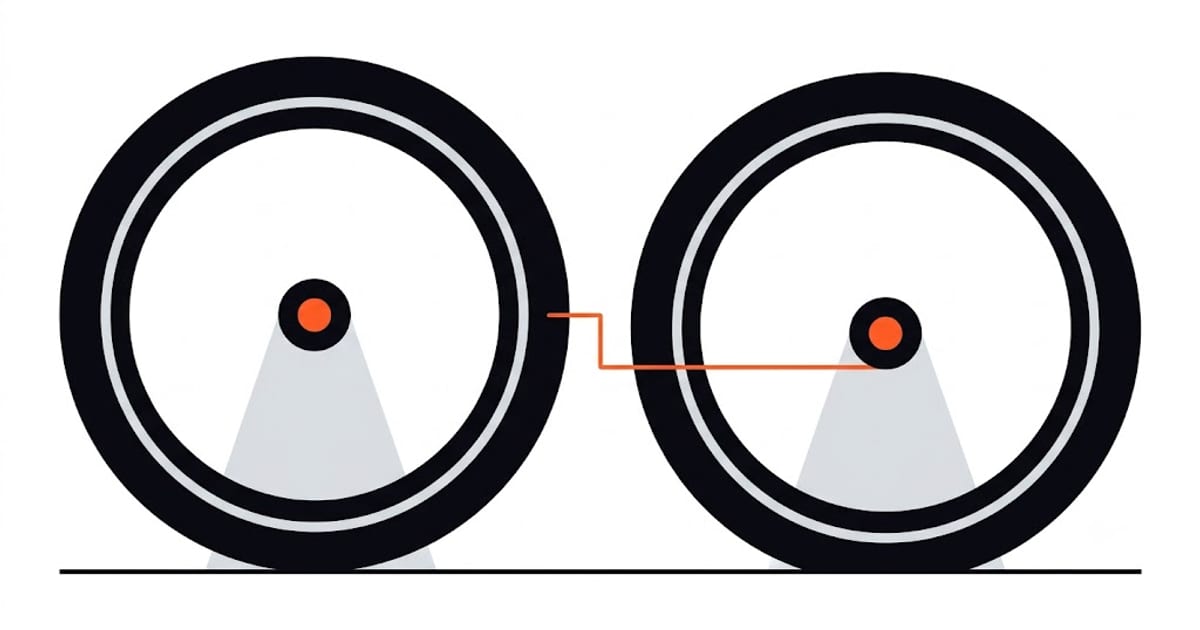
The number moulded into your tire sidewall — 120 PSI MAX, or 90, or 50 — is a structural limit. It is the pressure above which the manufacturer will not promise the casing stays on the rim. It is not a recommendation, and inflating to it is how most people end up riding tires far harder than anything they would choose if they knew what they were choosing.
The pressure you actually want depends on two things: how much weight that wheel carries, and how wide the tire is. Both are measurable in about two minutes.
Start with wheel load, not body weight
This is the mistake that makes most pressure advice useless. Your tires do not carry you. They carry you, plus the bike, plus whatever is bolted or strapped to it — and they split that total unevenly between two wheels.
For a road bike in a normal riding position the split is roughly 45 % front / 55 % rear. Sit up and it shifts rearward; get low in the drops and it moves forward. Add a saddlebag and it goes further back; add a handlebar bag and it comes forward.
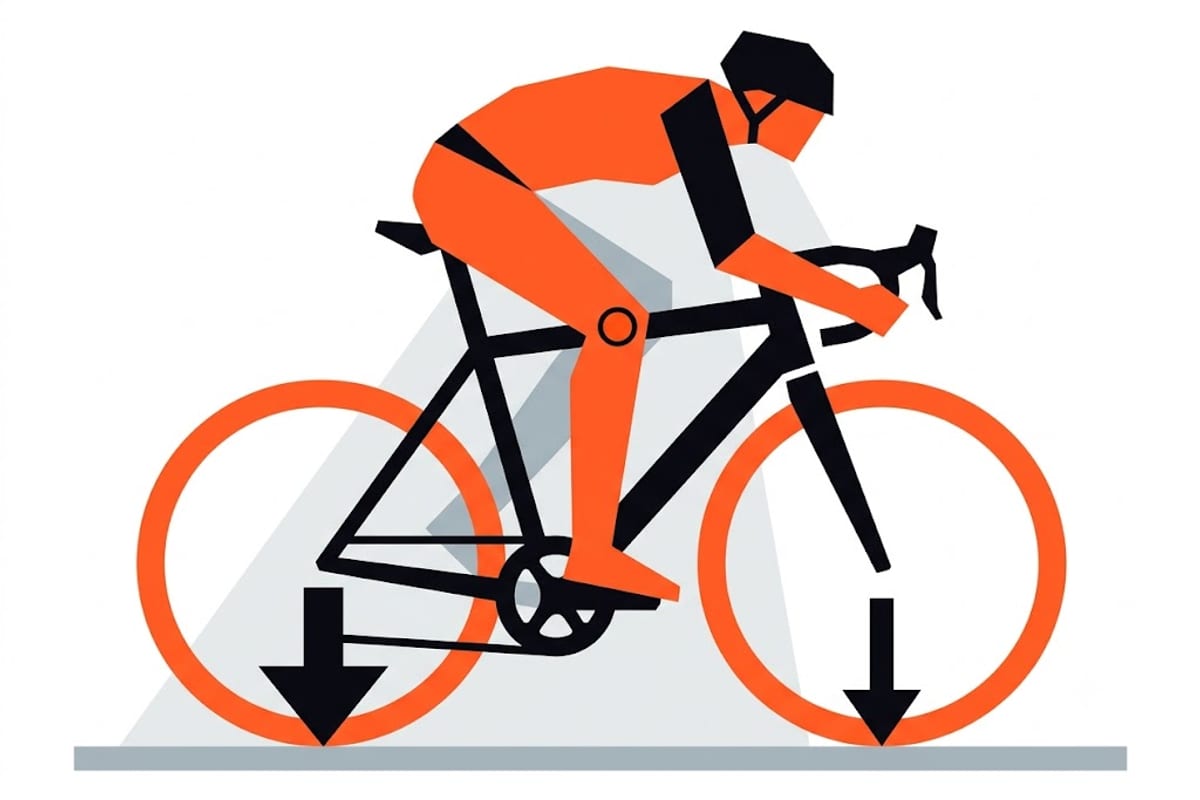
So an 82 kg rider on an 9 kg bike with 2 kg of kit is a 93 kg system, which lands as roughly 42 kg on the front wheel and 51 kg on the rear. Those are the two numbers that go into the table below, and they are different numbers — which is why your front and rear tires should not be at the same pressure.
If you want the split exactly rather than approximately, put your bathroom scale under one wheel and a book of the same thickness under the other, sit on the bike in your normal riding position with a hand on a wall, and read it. Then swap ends.
The 15 % tire drop principle
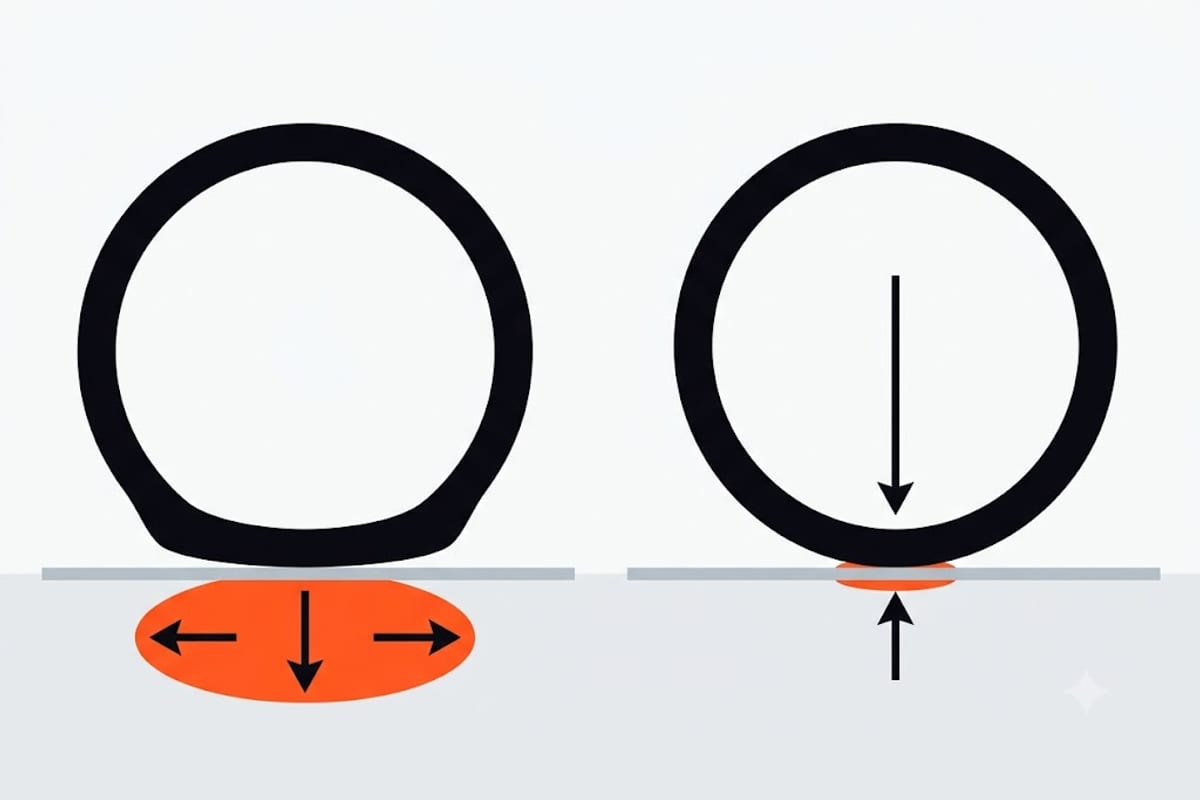
A tire under load flattens, and the axle sits lower than it would on an uninflated-but-rigid wheel. That vertical distance is tire drop, and it is the thing worth targeting.
The research is Frank Berto's, published in Bicycle Quarterly. He measured 50 tires at seven pressures from 40 to 160 psi and eight loads from 20 to 220 lbs per wheel, and produced a chart of the pressure needed to reach a given tire drop. Jan Heine's rolling-resistance testing then found that the pressure where tire resistance stops improving — beyond which higher pressure buys no speed but costs a great deal of comfort — corresponds to a tire drop of about 15 %.
That is the whole idea. Below the cut-off you are slow because the casing is doing too much work. Above it you are not faster, just harsher, and on real road surfaces you are usually slower again because the bike starts bouncing instead of the tire deforming.
The table
Read down to your wheel load, across to your measured tire width, and take the pressure.
| Wheel load | 23 mm | 25 mm | 28 mm | 32 mm | 35 mm | 38 mm | 40 mm | 45 mm | 50 mm |
|---|---|---|---|---|---|---|---|---|---|
| 30 kg | 66 | 57 | 47 | 38 | 32 | 28 | 26 | 21 | 18 |
| 35 kg | 77 | 67 | 55 | 44 | 38 | 33 | 30 | 25 | 21 |
| 40 kg | 88 | 77 | 63 | 50 | 43 | 38 | 34 | 28 | 24 |
| 45 kg | 99 | 86 | 71 | 57 | 49 | 42 | 39 | 32 | 26 |
| 50 kg | 110 | 96 | 79 | 63 | 54 | 47 | 43 | 35 | 29 |
| 55 kg | 121 | 105 | 87 | 69 | 59 | 52 | 47 | 39 | 32 |
| 60 kg | 132 | 115 | 95 | 75 | 65 | 56 | 52 | 42 | 35 |
| 65 kg | 143 | 124 | 103 | 82 | 70 | 61 | 56 | 46 | 38 |
All values in psi, for 15 % tire drop.
Where these numbers come from
Berto's published chart is a set of curves, not a formula, so we fitted one to it. Pressure turns out to scale linearly with load and with roughly the 1.7th power of width:
P (psi) ≈ 459 × L (kg) ÷ W (mm)1.70
The check that matters is whether it reproduces the worked example published alongside the original chart — a 100 kg rider-and-bike at a 45/55 split, giving wheel loads of 45 kg and 55 kg:
| Case | Published | This formula |
|---|---|---|
| 20 mm, 45 kg | 125 psi | 126 psi |
| 20 mm, 55 kg | 155 psi | 154 psi |
| 37 mm, 45 kg | 45 psi | 44 psi |
| 37 mm, 55 kg | 53 psi | 54 psi |
Within about 1 psi across a 110 psi span. Source: Optimizing Your Tire Pressure for Your Weight, Jan Heine, reprinted from Bicycle Quarterly.
Notice what the exponent means in practice. Because width enters at the 1.7th power, going 4 mm wider drops your pressure far more than losing 4 kg does. A 28 mm tire at 45 kg wants 71 psi; a 32 mm tire under the same rider wants 57. To get the same 14 psi reduction by losing weight you would have to shed nine kilograms.
Measure the tire, do not read it
A tire marked 28 mm does not necessarily measure 28 mm. Casing width depends on the internal width of the rim it is mounted on: the same tire on a modern 21 mm internal rim will measure several millimetres wider than it did on the 15 mm rims that were standard when most tires were labelled.
Take a caliper to the inflated tire at riding pressure. If it measures 30 mm, use the 30 mm column — you are entitled to run lower pressure than the label suggests, and reading the label instead of the tire is the second most common way people end up over-inflated.
Where this chart is conservative
Berto's measurements are from the 1990s, when a 25 mm tire was considered generous and tubes were universal. Two things have changed since:
- Tubeless removed the floor. With an inner tube, going too low risks a pinch flat — the tube being crushed between rim and obstacle. That risk set a practical minimum that had nothing to do with rolling resistance. Tubeless removes it, so riders can now access pressures the chart's users could not safely use. See how tubeless changes your pressure.
- Rough surfaces have a different optimum. The 15 % criterion is a good general target, but on genuinely rough ground the fastest pressure is lower than on smooth tarmac, because energy lost to the bike and rider bouncing exceeds what is lost in casing deformation. This is why gravel and trail pressures sit well below what the table suggests for the same width.
Treat the table as your starting point on tarmac, and as an upper bound off it. For surfaces the chart was never built for:
- Road bike tire pressure chart — the table narrowed to road widths, with the front/rear split done for you.
- Gravel tire pressure by rider weight — where and why to sit below the 15 % number.
- MTB tire pressure for trail riding — the widths where the chart runs out, and what replaces it.
FAQ
What pressure should I run in my bike tires?
It depends on the load on each wheel and the measured width of each tire, not on your body weight alone. Find your wheel loads by splitting your total rider-plus-bike weight roughly 45 % front and 55 % rear, then read the pressure from the table above.
Should front and rear tires be at the same pressure?
No. The rear wheel typically carries about 55 % of the total load against the front's 45 %, so at the same tire width the rear wants roughly 20 % more pressure. Running them equal means one of the two is wrong.
Is the maximum pressure on the sidewall the recommended pressure?
No. It is a structural limit set by the manufacturer for safety, marking the point above which the tire is no longer guaranteed to stay seated. Most riders are correctly served by a pressure well below it.
Does higher pressure make me faster?
Only up to a point, and that point is lower than most people assume. Rolling resistance falls as pressure rises until it levels off; past that, extra pressure adds no speed. On rough surfaces it makes you measurably slower, because the whole bike and rider begin to bounce rather than the tire absorbing the surface.
Do wider tires need less pressure?
Substantially less. Pressure scales with roughly the 1.7th power of width, so a 32 mm tire needs about 20 % less pressure than a 28 mm tire carrying exactly the same load.