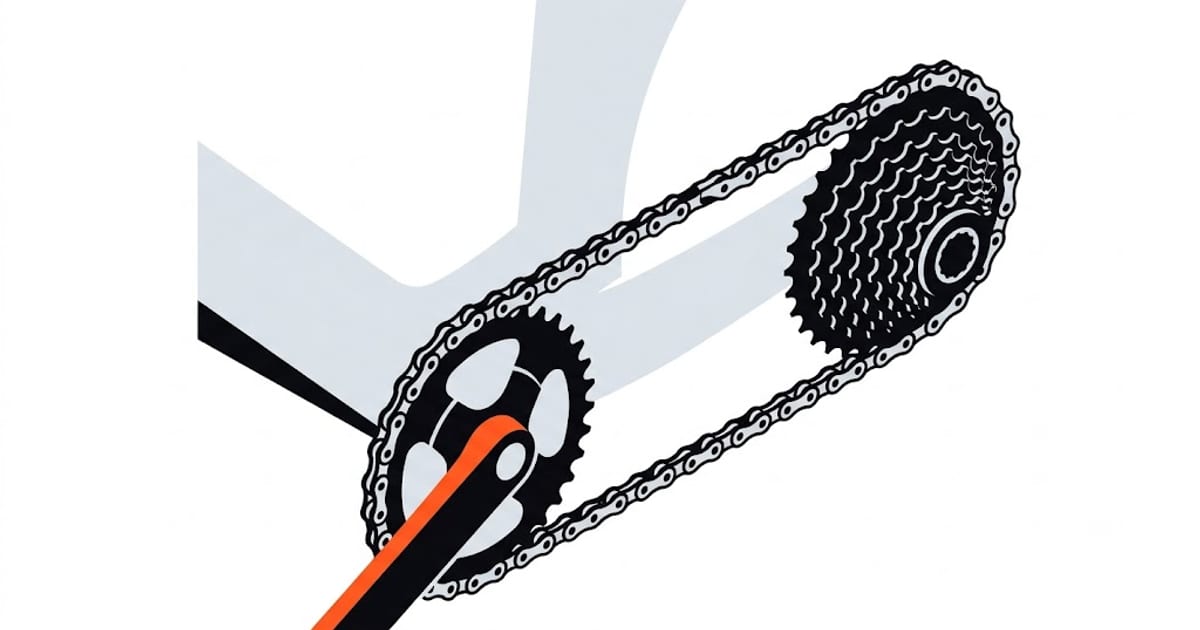
Chainline is the distance from the frame centreline to the chainring — or to the middle of the cassette at the back. When the two agree, the chain runs straight in the middle gears.
Cross-chaining is running the chain at an extreme sideways angle: big ring to biggest sprocket, or small ring to smallest.
Why it costs something
A chain is designed to articulate in one plane. Force it sideways and:
- Side plates rub against sprocket and chainring teeth.
- The chain flexes laterally through every link, in every revolution.
- Friction rises, so some of your effort turns into heat and wear instead of forward motion.
The audible noise in big-big is the drivetrain telling you this directly. Noise is wasted energy.
Which combinations
On a 2× road drivetrain:
- Big ring + biggest 2 sprockets — avoid.
- Small ring + smallest 2 sprockets — avoid.
- Everything else is fine.
The useful part is that both cases have a better alternative available. Big-big and small-small produce ratios that also exist as a comfortable middle-gear combination on the other ring — you can get the same gear without the angle, usually with one front shift.
That is the real argument. Not that cross-chaining destroys drivetrains, but that it is unnecessary.
How bad is it, honestly
Less bad than it used to be. Modern chains flex laterally far better than chains of twenty years ago, and manufacturers design for the angles their own systems produce.
Occasional cross-chaining — the last stretch of a climb, a short sprint where shifting is inconvenient — is not going to ruin anything. Riding permanently in big-big will wear the drivetrain faster and waste watts the whole time.
Treat it as inefficient rather than dangerous, and let that set how much you care.
1× changed the rules
A single-ring drivetrain has no straight-chainline option at the extremes. With a 12-speed cassette, the chain must run at a substantial angle in the outermost sprockets — there is nowhere else for it to be.
Manufacturers design around this: narrow-wide chainrings, chains with more lateral flex, and chainline positions chosen to split the difference across the cassette.
So on 1×, the outer gears are not a mistake to avoid — they are part of the intended range. The cost is real but it is priced in, and it is one of the trade-offs behind 1× against 2×.
When chainline is actually wrong
Noise in the middle of the cassette is not cross-chaining. It is a chainline problem, and it has causes:
- Bottom bracket spacers in the wrong arrangement.
- Boost and non-boost hub spacing mixed, which shifts the rear chainline several millimetres.
- A chainring designed for a different frame standard.
- A bent derailleur hanger, which is the most common and the cheapest to check.
If the drivetrain is noisy where it should be quiet, measure the chainline rather than adjusting the derailleur again. Compatibility standards that affect it are in drivetrain compatibility.
FAQ
What is cross-chaining?
Running the chain at an extreme sideways angle — big chainring to biggest sprocket, or small ring to smallest.
Is cross-chaining really bad?
It adds friction and wear rather than causing damage. It is worth avoiding mostly because the same gear is available without the angle.
Which gears should I avoid?
Big ring with the largest two sprockets, and small ring with the smallest two.
Is cross-chaining a problem on 1x drivetrains?
No. With one chainring the chain must run at an angle in the outer sprockets, and the system is designed for it.
Why is my drivetrain noisy in the middle gears?
That is a chainline problem, not cross-chaining. Check the derailleur hanger first, then bottom bracket spacing and hub standard.